Service
Technical care, website maintenance and SLA
Ongoing technical care and support: updates, backups, monitoring, security and performance — with a defined scope, response time and reporting.
Website maintenance is an agreement that removes the "nobody is watching this" problem: a defined scope, a guaranteed response time and one person accountable for the technical state. Most technical problems companies bring to me are not caused by a lack of skill but by a lack of process: updates postponed for months, backups nobody ever tested, no one watching security and performance, and small fixes waiting weeks for a quieter moment. Technical care covers websites (WordPress), stores (WooCommerce, PrestaShop) and applications (Laravel) — from staged updates and tested backups to 24/7 monitoring, security, performance and a monthly report. You do not need to understand the technology to be sure someone is looking after it.
Last updated: 27.10.2026
Budget range
300 – 2 000 PLN / month
Final fixed price after a free scope analysis — no hidden costs.
Administration versus care — a difference that matters
Administration is a list of tasks: update, back up, check uptime. Care is an agreement to deliver them — with a plan, a response time, reporting and accountability for the outcome. The difference shows up during an incident: with administration you hear "that was not in scope", with care you have a documented response time and a recovery procedure. The second difference is initiative: administration waits for a ticket, care watches the system and reports problems before your customers notice them.
What technical care covers
Updates of the core, plugins, modules and themes — always on staging first, never straight to production. Backups with periodic restore tests, because a backup you never restored is not a backup. Monitoring of uptime, errors and load times with alerts. Security: vulnerability patches, permission reviews, protection against unauthorised access. Small fixes and content changes within the plan hours. A monthly report covering the work done and the state of the system. The plan also keeps technical SEO in shape — structured data, indexation and visibility in Google.

Plans and response times
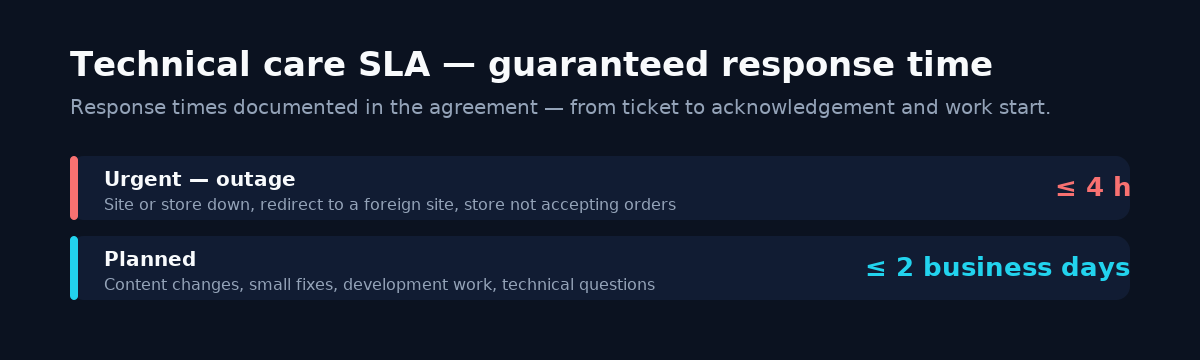
The basic plan covers updates, backups, monitoring and small fixes — from 300 PLN net per month for a site and 400 PLN for a store. The standard plan adds a faster response time, a block of hours for changes and a quarterly performance and security review. A development retainer with SLA and a full hour block starts at 2 000 PLN net per month — for stores and applications that evolve continuously. Response time depends on the plan and ranges from 4 hours in urgent mode to 2 business days. All plans are billed as a monthly subscription, with scope and exclusions written into the agreement — no setup fees and no hidden costs.
Taking over care from a previous contractor
I regularly take over care from other contractors. I start with an inventory: hosting, domain and panel access, the plugin and module list, verification of code ownership, backup state and PHP and core versions. Only then do I clean up the environment: removing unnecessary extensions, configuring staging, enabling monitoring and establishing an update cycle. If a previous contractor withholds access, I help establish who owns the domain and the code and recover control of the project.
For WordPress, PrestaShop and Laravel applications
The scope is tailored to the platform. For WordPress that means core, plugin and theme updates, security and plugin clean-up. For PrestaShop — module updates, database and cache performance, and correct marketplace and carrier integrations. For Laravel applications — dependency updates, regression tests, queue and scheduler monitoring, log reviews. In every case the same rule applies: changes go through staging, and the state of the system is measured rather than judged by feel.
Online store care — WooCommerce and PrestaShop
A store is the most demanding system under care: every minute of downtime is lost orders. In WooCommerce and PrestaShop care plans I test the full purchase path after every update — cart, checkout, payments (BLIK, Przelewy24, PayU) and transactional emails. I watch database and cache performance and the correctness of marketplace (Allegro), carrier (InPost, DHL, DPD) and ERP integrations. Orders and stock levels are monitored so that drift is caught before customers notice it. Store care also covers Omnibus compliance and WCAG accessibility — a real penalty risk, not a nice-to-have.
Security: malware, attacks and infection prevention
Security is daily work, not one-time configuration. The care plan includes: malware scanning, vulnerability patches in the core, plugins and modules, account and permission reviews, two-factor authentication (2FA), an application firewall (WAF) and file integrity monitoring. When infection is suspected — redirects to foreign sites, SEO spam, unexpected admin accounts — I trace the entry vector, clean the files and database and bring the site back into the Google index. Sites after an attack usually come to me precisely to return to search results and never get infected again.
Performance and Core Web Vitals — speed as part of care
A slow site loses visitors and Google positions. In the care plan I measure and maintain Core Web Vitals: LCP (largest contentful paint), INP (interaction responsiveness) and CLS (layout stability). In practice: server-level cache (Nginx, Redis), WebP and AVIF images, lazy loading, fewer external scripts, a clean database and lean theme code. The target for sites under care: LCP under 2.5 s on mobile. Performance goes into the monthly report as numbers, not claims.
Monitoring and monthly work report
Monitoring runs 24/7: uptime, load times, PHP errors and the SSL certificate. You get the alert together with me — before your customers notice. Every month ends with a work report: updates with dates, backup and restore-test confirmation, security scan results, uptime percentage, load times (Core Web Vitals) and recommendations for the next month. You know exactly what was done and in what state the system is — no guessing and no surprise invoices.
Support, administration and maintenance — what to call it
The same scope of work goes by three names: technical support (responding to tickets), website administration (a task list: update, back up, check) and website maintenance (keeping the system running). The difference is not the name but the accountability: who answers the ticket, within what time, and who watches the system when nobody reports a problem. In my plans all three are part of one agreement: tickets come in by email and phone, administration runs on a schedule, and maintenance is measured — uptime, performance and security go into the monthly report.
Remote care — Gdańsk, Tricity and companies across Poland
Care is delivered remotely, so location does not affect the quality of support — I work with companies in Gdańsk, Gdynia and Sopot, across Poland and abroad. For Tricity companies an on-site meeting is possible for a project takeover or audit. The remote model means tickets come in by email and phone, every change goes through staging and everything is documented in the report — wherever your company is based.
Packages and rates
Three levels of care — from the basic plan to a development retainer with SLA. Each plan is quoted after a free scope analysis; you can move between plans as your system evolves.
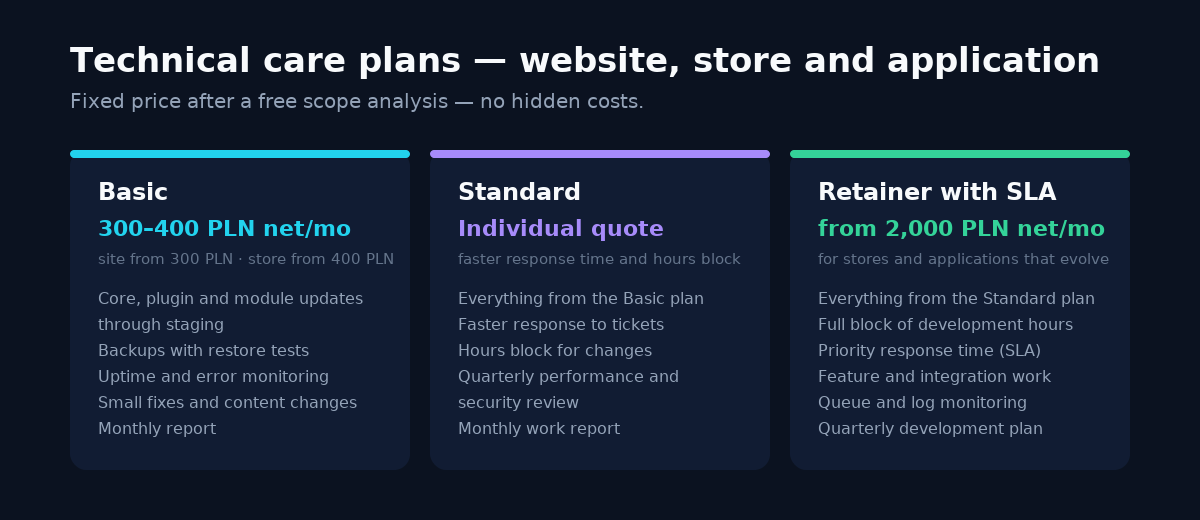
Basic plan
300–400 PLN net/mo
site from 300 PLN · store from 400 PLN
Core, plugin and module updates through staging, backups with periodic restore tests, uptime, error and load-time monitoring, security (vulnerability patches, permission reviews) and small fixes and content changes within the plan.
- Updates always through staging
- Backups with restore tests
- 24/7 monitoring with alerts
- Small fixes and content changes
Standard plan
Individual quote
faster response time + hours block
Everything from the basic plan, plus: a faster response time, a block of hours for changes and development, and a quarterly performance and security review with recommendations.
- Faster response time
- Hours block for changes and development
- Quarterly performance and security review
- Monthly report with recommendations
Development retainer with SLA
from 2,000 PLN net/mo
stores and applications that evolve
A full block of development hours, priority response time (SLA), feature and integration work, queue and scheduler monitoring, and a quarterly development plan — for stores and applications that evolve continuously.
- Priority response time (SLA)
- Full block of development hours
- Queue, log and scheduler monitoring
- Quarterly development plan
Technology stack
Legal basis and standards
Related services
- WordPress maintenance & care Sites and WooCommerce stores under technical care.
- PrestaShop stores Store support: modules, performance and integrations.
- PrestaShop technical help Failure repairs, diagnostics and ongoing store care with a response time.
- WordPress malware removal Infection cleanup, hardening and getting back into the Google index.
- Legacy PHP modernization When care is not enough and an audit plus refactoring is needed.
- Pricing Care plan ranges, engagement models and hour blocks.
- Taking over a WordPress site from another vendor Inventory, access recovery and a safe handover checklist — the first step of care.
Worth reading
- Website maintenance — scope, plans and costs What website maintenance covers, how plans differ and what it costs.
- WordPress website care — plans and SLA What care covers, how it differs from administration and how to choose a plan.
- WordPress administration — scope and pricing How administration differs from care and what it should include.
- WordPress technical support — when you need it What technical support covers, when to book it and how it works.
- PrestaShop support — scope and response time Store maintenance, module updates and bug fixing.
- PrestaShop maintenance services — care plans Updates, backups, monitoring and security for PrestaShop stores.
- WordPress updates — a safe process Why updating on production is a risk and how to do it properly.
- Taking over a WordPress site from another vendor Inventory, access recovery and a safe handover checklist.
- WordPress staging — a safe testing environment How staging prevents production failures during updates.
- Website monitoring — uptime, performance and security What to monitor, how alerts work and what the monthly report shows.
FAQ
How much does technical care for a site or store cost?
The basic plan starts at 300 PLN net per month for a site and 400 PLN for a store. It covers updates, backups, monitoring and small fixes. The standard plan with a faster response time and a block of hours is quoted individually. A development retainer with SLA and a full hour block starts at 2 000 PLN net per month.
How is care different from administration?
Administration is a list of tasks; care is an agreement to deliver them with a guaranteed response time, reporting and accountability for the outcome. With care, the contractor watches the state of the system and reports problems rather than only reacting to client tickets.
Are updates safe for my site?
Yes, provided they go through staging. Every update is applied to a copy of the site first, key functionality is checked, and only then is it published to production. A backup is taken before each change, so a quick rollback is always possible.
How fast do you respond to an incident?
Response time depends on the plan and ranges from 4 hours in urgent mode to 2 business days for planned changes. I take requests by email and phone. For an incident affecting sales or business operations the priority is highest regardless of the plan.
Will you take over care from another contractor?
Yes, I do this regularly. I start with an inventory: hosting and domain access, the plugin list, backup state, PHP and core versions, and verification of code ownership. If a previous contractor withholds access, I help establish who owns the domain and the code.
Does care cover content changes and new features?
Small content changes and fixes are included in the basic plan within an agreed limit. Larger changes, new features and development work are billed within the standard plan hour block or the development retainer. The scope is agreed upfront so there are no surprises on the invoice.
What is an SLA and what response time do I get?
An SLA is a contractual response time. In my plans: urgent tickets (site or store down, redirect to a foreign site, store not accepting orders) are answered within 4 hours; planned changes and small tasks within 2 business days. Incidents affecting sales get top priority regardless of the plan. The response time is written into the agreement rather than left to the contractor's goodwill.
Does care cover a WooCommerce or PrestaShop store?
Yes — stores get an extended scope: after every update I test the full purchase path (cart, checkout, payments, transactional emails) and watch database and cache performance plus marketplace (Allegro) and carrier (InPost, DHL, DPD) integrations. Stores have their own plan pricing — from 400 PLN net per month. See the article on WooCommerce store care for the full scope.
Do you remove malware and protect against attacks as part of care?
Yes. Care includes malware scanning, vulnerability patches in the core, plugins and modules, account and permission reviews, two-factor authentication (2FA), an application firewall (WAF) and file integrity monitoring. If a site has been infected, I trace the entry vector, clean files and database and bring the site back into the Google index — the full scope is described on the WordPress malware removal service page.
Does care include performance optimisation and Core Web Vitals?
Yes — performance is part of care. I measure and maintain Core Web Vitals (LCP, INP, CLS), configure server-level cache (Nginx, Redis), WebP and AVIF images and clean up the database. The target for sites under care: LCP under 2.5 s on mobile. Results are reported monthly with numbers, not claims.
How long does taking over care from a previous contractor take?
I start with an inventory: access (hosting, domain, panel), the plugin and module list, backup state, PHP and core versions and verification of code ownership. The inventory usually takes 2–5 business days, after which I clean up the environment: remove unnecessary extensions, configure staging, enable monitoring and set the update cycle. If a previous contractor withholds access, I help establish who owns the domain and the code and recover control of the project.
What is the difference between technical support, administration and website maintenance?
Technical support is responding to tickets, website administration is a task list (updates, backups, reviews), and website maintenance is keeping the system running. In my plans all three are part of one agreement: tickets come in by email and phone, administration runs on a schedule, and the system state is measured (uptime, performance, security) and reported monthly. You do not have to decide what to call it — describe what you have and you will get a scope that fits.
What does the monthly care report contain?
The work report contains: updates with dates, backup and restore-test confirmation, security scan results, uptime percentage, load times (Core Web Vitals) and recommendations for the next month. Based on it you decide what we do next — no guessing and no surprise invoices.
Do you work with companies outside Poland?
Yes — care is delivered remotely for companies in Gdańsk, Gdynia and Sopot, across Poland and abroad. Tickets come in by email and phone, every change goes through staging and everything is documented in the report. For Tricity companies an on-site meeting is possible for a project takeover or audit.
Krzysztof Słonina
Senior full-stack developer, owner of Inoventis Solutions
16 years in PHP, WordPress and Laravel: technical care, security and performance for websites and stores. I run care plans with SLA, monthly reporting and full work documentation.
Results from real projects
PHP application modernization
Zero critical incidents for 12 months
Read the case studyCRM application and client portal
50% less time on administrative work
Read the case studyIndicative ranges for this service: see pricing
Web app requirements checklist
12 control questions to answer before talking to a vendor — faster estimates, fewer hidden costs.
Want to be sure someone is looking after your site?
Tell me what you have (site, store, application) and which platform it runs on. I will reply with the plan that makes sense and what I would find to fix at the start — no obligation.
Ask about care