Service
E-commerce & API Integration Services
Connecting sales channels, automating data flow.
Running an online store across several channels? Moving data by hand between your store, ERP system, marketplaces and accounting is not just a waste of time — it is the main source of errors. I design and build e-commerce integrations that connect your online store with the systems around it into one coherent ecosystem — from single connections to multi-channel systems with queues and monitoring. 120+ integrations shipped over 16 years.
Last updated: 27.10.2026
Budget range
4,000 – 30,000 PLN
Final fixed price after a free scope analysis — no hidden costs.
What e-commerce integration actually is
An e-commerce integration is an automated connection between your online store and the systems around it: marketplaces, an ERP system, accounting, payments, carriers or CRM. Data — orders, stock levels, prices, invoices, tracking numbers — flows between systems without manual work, either on a schedule or in real time through APIs and webhooks. The result: no re-typing, no duplicate orders and one consistent stock level across every sales channel. Integration is the layer that turns a shop into a sales system — without it, every channel you add multiplies manual work instead of revenue.
What full online store to ERP integration covers
Full e-commerce integration with an ERP system means an automatic, two-way flow of data between your online store (e.g. WooCommerce, PrestaShop, Shopify, Shoper) and the ERP. In practice it comes down to four areas — if any of them is still handled manually, the whole integration starts to drift:
Products and prices
Automatic transfer of new items between the store and the ERP: descriptions, categories, images and prices — including individual price lists, promotions and discounts. One source of truth for product data instead of manual re-typing and guessing which version is current.
Stock levels
Real-time stock synchronisation: a purchase in the store immediately reduces stock in the ERP, and stock levels from the warehouse — including multiple locations — flow back to the store and marketplaces, with a safety buffer that prevents selling items you physically do not have.
Orders and payments
Orders from the store and marketplaces land in the ERP automatically, where sales documents (invoices, delivery notes, receipts) are created and fulfilment is handled, while order and payment statuses flow back to the customer and to the sales channel. No re-typing and no orders lost between systems.
Customer base (CRM)
Buyer data flows into contractor records in the ERP and into CRM: order history, segments, statuses and consents. A complete picture of B2C and B2B customers in one place — without manually creating records or duplicates.
Key benefits of integration — time, errors, customer service, scale
Integrating your online store with the company's systems is not a project "for the sake of order" — it translates into concrete effects you can see in daily team work and sales results:
Time savings
No more re-typing orders, invoices, stock levels and customer data between panels. Clients typically recover 10–20 hours of manual work per week — time that goes back into sales and customer service instead of disappearing into switching between systems.
Fewer errors
Manual data entry is the most expensive error class: duplicate orders, stock drift, invoices without orders and phantom orders. Integration eliminates them at the source — through validation, idempotency, retry queues and daily reconciliation reports.
Better customer service
Current stock and prices, faster shipping, automatic shipment status notifications and full order history in one place. Customers get their goods and answers faster, and you get fewer complaints and returns caused by mistakes.
Scalability
Another sales channel — Allegro, Amazon, eBay, Empik, eMAG — can be added without a proportional increase in operational work. Multi-channel sales, marketplaces and B2B grow without rebuilding the team or hiring people just to re-type data.
What we connect — the integration map
E-commerce integrations cover everything around your store: sales platforms, marketplaces, ERP, accounting, payments, carriers, wholesalers and CRM. Marketplaces: Allegro, Amazon, eBay, Empik, eMAG. ERP and warehouse: Subiekt GT, Subiekt nexo, Comarch ERP Optima, Comarch ERP XL, enova365, SAP, Microsoft Dynamics 365 plus WMS and OMS systems. Accounting and invoicing: Fakturownia, iFirma, Comarch, KSeF. Payments: PayU, Tpay, Przelewy24, Stripe, BLIK. Carriers and fulfilment: InPost, DHL, DPD, GLS, FedEx. Wholesalers and dropshipping: automatic stock, pricing and supplier orders. CRM and marketing: HubSpot, Salesforce, Zoho, mailing and analytics tools. Store platforms: WooCommerce, PrestaShop, Shopify, Magento, Shoper, IdoSell, Sellasist, Sky-Shop. Price comparison and product channels: Ceneo and Google Merchant Center. And any custom back-end or internal system with no off-the-shelf connector — through its API or a dedicated middleware layer.
| Category | Systems | What we synchronise |
|---|---|---|
| Marketplaces | Allegro, Amazon, eBay, Empik, eMAG | offers, orders, stock and prices, shipment statuses |
| ERP and warehouse | Subiekt GT, Subiekt nexo, Comarch ERP Optima, Comarch ERP XL, enova365, SAP, Microsoft Dynamics 365 | orders → ERP, stock and prices → store, product records, contractors, sales documents |
| Accounting and KSeF | Fakturownia, iFirma, Comarch, KSeF | invoices, payment statuses, credit notes, returns, e-invoices |
| Payments | PayU, Tpay, Przelewy24, Stripe, BLIK | transactions, refunds, express checkout, GA4 |
| Carriers and fulfilment | InPost, DHL, DPD, GLS, FedEx, WMS, OMS | labels, tracking numbers, delivery statuses |
| Wholesale and dropshipping | B2B wholesalers, XML/CSV feeds, supplier APIs | stock, prices, automatic supplier orders |
| CRM and marketing | HubSpot, Salesforce, Zoho, GA4, Merchant Center | customer data, segments, product feed, sales measurement |
| Store platforms | WooCommerce, PrestaShop, Shopify, Magento, Shoper, IdoSell, Sellasist, Sky-Shop | products, stock, orders, customers — both ways |
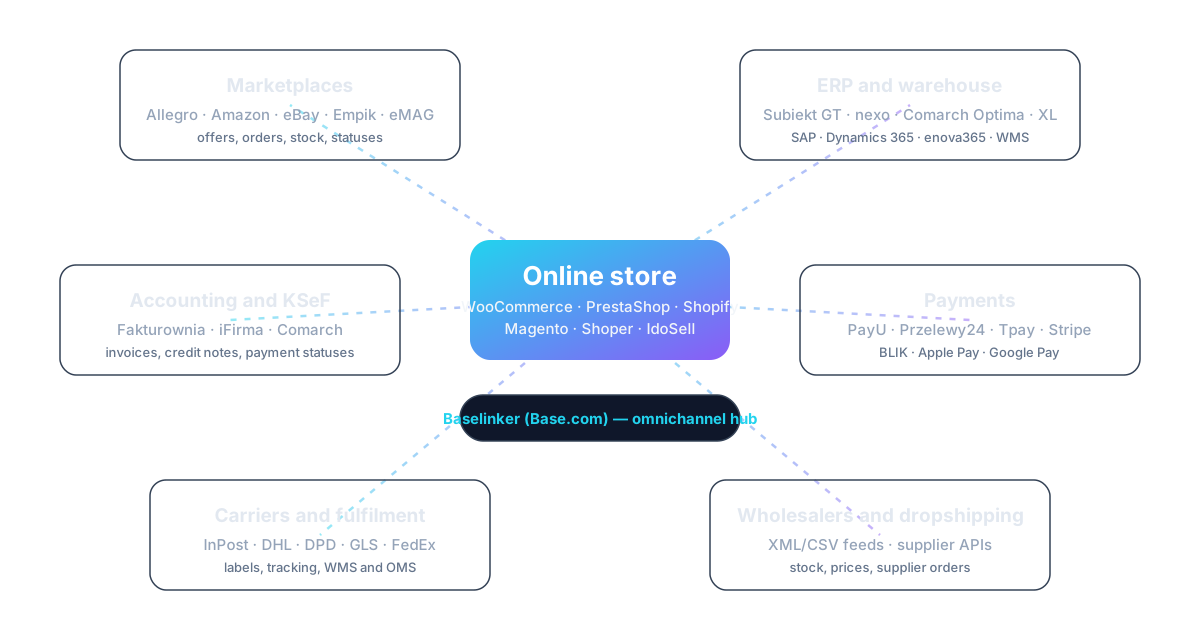
E-commerce ERP integration — Subiekt, Comarch, SAP and Dynamics 365
E-commerce ERP integration is the most common and most important connection in the whole sales ecosystem. It means automatically connecting your online store with the ERP system that manages sales, warehouse, accounting and customer service. Orders from e-commerce land in the ERP automatically — no re-typing — and the ERP pushes current stock levels and prices back to the store. The ERP then generates sales documents (invoices, delivery notes, receipts), updates product records and contractors, and feeds data to the carrier system. I most often connect Subiekt GT and Subiekt nexo (via Sfera or a dedicated integration layer), Comarch ERP Optima and Comarch ERP XL (via Comarch Web API), as well as enova365, SAP and Microsoft Dynamics 365 — through web services or file-based exchange. The result: store stock matches the warehouse to the unit, invoices create themselves, and customer service sees the full order history.
| ERP system | Integration via | Typical scope |
|---|---|---|
| Subiekt GT | Sfera (InsERT GT) or a middleware layer | product records, stock, prices, orders, sales documents, contractors |
| Subiekt nexo | Sfera nexo / API | orders → ERP, stock and prices → store, warehouse documents, multi-warehouse |
| Comarch ERP Optima | Comarch Web API / file exchange | stock and price sync, order export, invoices, customer data |
| Comarch ERP XL | Comarch Web API | orders, multi-warehouse stock, price lists, trade documents |
| enova365 | enova365 API / web services | products, stock, orders, invoices, settlements |
| SAP / Microsoft Dynamics 365 | web services, file exchange, middleware | orders, stock, prices, documents, multi-channel integration |
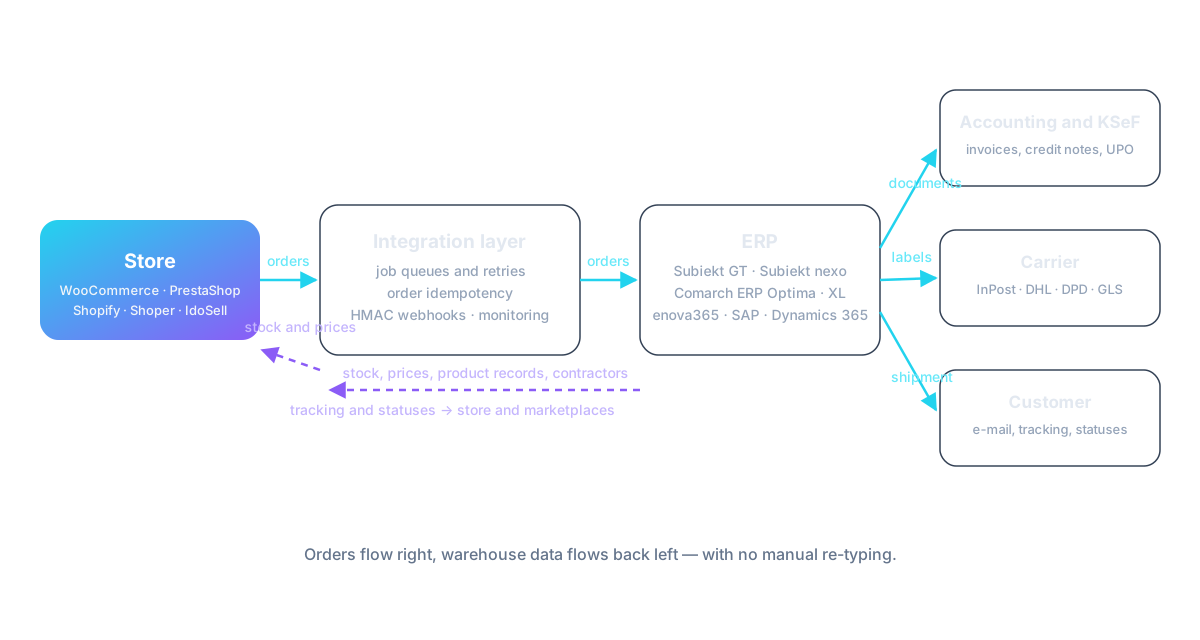
KSeF and accounting integration — invoices without manual work
From 2026, KSeF (Poland's national e-invoicing system) becomes mandatory — large taxpayers join in February, the rest in April 2026. For online stores this means every B2B invoice goes through the system and data must flow without manual re-typing. Integration between e-commerce and accounting software — Fakturownia, iFirma, Comarch or KSeF directly — automates the whole chain: an order creates an invoice, the invoice passes through KSeF and comes back with its KSeF number and UPO confirmation, payment statuses and credit notes sync both ways, and returns never require re-keying. Marketplace sales, where the invoice is often issued by the platform, are reconciled so VAT and documents match channel by channel.
Wholesalers, dropshipping and fulfilment
Selling without your own warehouse requires airtight integration: automatic stock and prices from the wholesaler (XML/CSV feed or supplier API), supplier orders placed without manual work, availability updated after every change. For dropshipping models, wholesale integration means no re-typed orders and zero phantom orders — products sold when the supplier's stock was already gone. Larger operations get connected to WMS, OMS and fulfilment systems: multi-warehouse stock allocation, order routing to the right fulfilment centre and one consistent picture of online sales (omnichannel). Sales grow without the warehouse becoming the bottleneck.
Popular integration methods — plugins, iPaaS hubs, dedicated APIs
You will find four approaches to connecting a store with business systems, each with a different use case. 1) Ready-made plugins and modules: the cheapest and fastest option, but limited to standard flows — they break down as soon as your pricing, stock or order logic deviates from the default. 2) Middleware platforms (hubs, iPaaS): Base.com (Baselinker), xSale or SellIntegro — one subscription connects hundreds of systems through ready-made connectors, ideal for commodity sales channels. 3) Dedicated middleware: built for your process when a hub does not fit — individual B2B price lists, multi-warehouse stock, approval workflows, non-standard documents. 4) Direct API connection: for simple, stable one-way flows. In practice the best results come from a hybrid: a hub (iPaaS) for standard channels plus a dedicated layer where your competitive advantage lives — stock allocation, pricing rules or order routing.
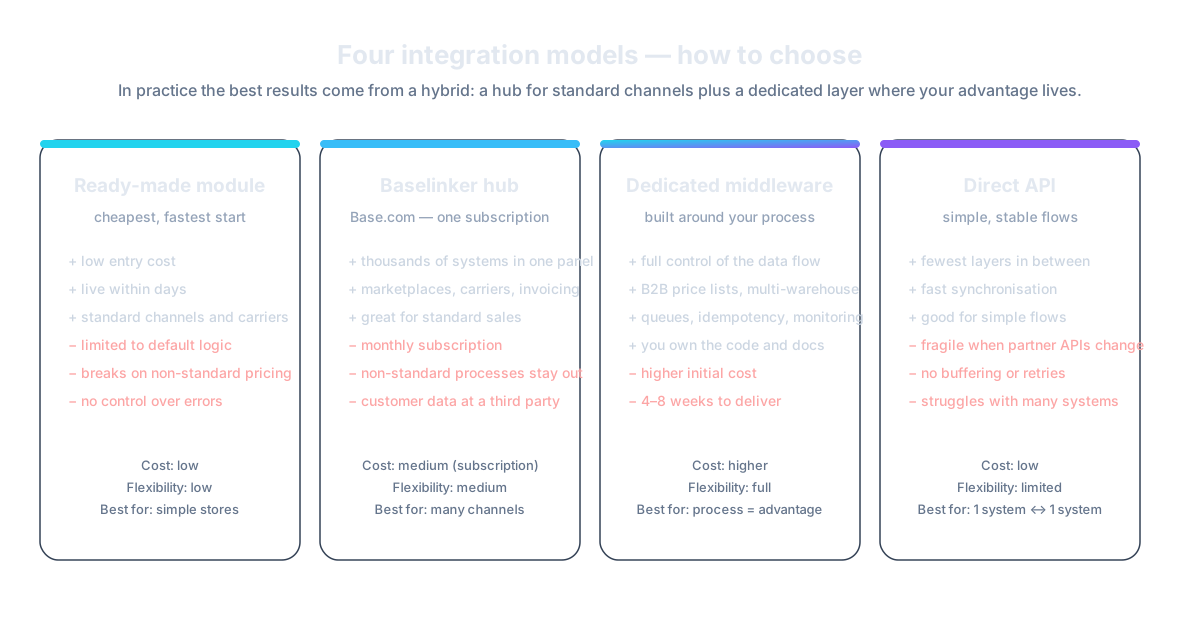
E-commerce integrator — when you need a partner, not another plugin
A ready-made module or hub is enough as long as your process is standard. An e-commerce integrator steps in when: pricing and stock logic is non-standard, you sell B2C and B2B in parallel, you run several warehouses or wholesalers, documents must comply with KSeF and GDPR, and nobody in the company wants to maintain integrations as partner APIs keep changing. As an integrator I take responsibility for the whole cycle: flow analysis and a fixed quote, data contract design, implementation with queues and monitoring, testing against partner sandboxes, and ongoing maintenance after launch. You get one person accountable for orders, stock and invoices matching across every system — instead of three plugins nobody can diagnose when they stop working.
How an integration project runs — 5 stages
1) Discovery: mapping data flows, volumes, edge cases and the cost of errors in each of them. 2) Design: choosing the model, defining the contract — fields, events, schedules, error handling, ownership of truth for each data point. 3) Build: implementation plus sandbox testing against partner APIs. 4) Testing: end-to-end scenarios, failure simulations, load tests on real volumes. 5) Launch and monitoring: alerts, an event log and reconciliation reports from day one. A single connection takes 1–2 weeks; a multi-channel system with queues, monitoring and error handling — 4 to 8 weeks.
Reliability engineering — why integrations break and how we prevent it
Partner APIs time out, change without notice and fail. We design for that reality: job queues with retries and exponential backoff, idempotent endpoints so a repeated webhook never duplicates an order, HMAC-signed webhooks, an event log with full history for every message, and alerting that fires before customers notice a problem. Stock and price drift is caught by daily reconciliation reports that compare both sides and flag differences. A failure of one system never stops sales — the queue holds and resumes automatically.
What you gain
Automatic stock, price and order synchronisation across every channel. Invoicing without manual entry. Labels and tracking numbers without copy-paste. A single dashboard showing the state of all sales channels. Clients typically recover 10–20 hours of manual work per week — and eliminate the most expensive error class: orders lost between systems, which surface as complaints from customers who paid but never received anything.
What it costs
A single connection — for example store to invoicing, or store to one marketplace — starts at 4,000 PLN net. A multi-channel system with queue-based processing, monitoring and error handling goes up to 30,000 PLN. Existing integrations can be taken over, repaired or extended: I start with a short audit and quote after it. Ongoing maintenance of integrations starts at 400 PLN net per month. The final price is fixed after a free scope analysis — and it does not change during the project.
Proven in production
Omnichannel integration for an e-commerce brand: API plus webhooks, resilient queues, full stock and order synchronisation between the store, marketplaces and the back-office. Order handling time was cut by 40% and duplicate orders disappeared entirely. The full architecture is described step by step in the case study — including the failure scenarios we designed for and how the queue behaves when a partner API goes down.
After go-live — maintenance and ownership
Partner APIs change several times a year — somebody has to keep the integration alive. I offer ongoing care: monitoring, updates after partner API changes, incident response and small extensions as your channels grow. You own the code and the documentation. There is no vendor lock-in: everything can be handed over to your in-house team with a walkthrough, and the event log gives you full visibility into what the integration did and when.
Popular integration pairs — where most projects start
Most projects start with a single pair of systems; further channels join once the first connection runs stably. The most frequently delivered pairs — each with a dedicated guide on the blog:
BaseLinker (Base.com) + Comarch ERP Optima
Orders and stock from every channel connected to Optima via Comarch Web API.
PrestaShop + Baselinker
Orders, stock and shipping labels from one panel — step by step.
Allegro + Subiekt GT
Allegro orders land in Subiekt, stock and prices flow back to Allegro.
Fakturownia and Base.com + store
Invoices without manual work: from order through documents to KSeF.
Shopify + ERP and carriers
Shopify Admin API, webhooks and synchronisation with ERP and shipping.
InPost + PrestaShop
Parcel lockers, ShipX API, labels, tracking and shipment statuses.
Integrations for B2B and multi-warehouse operations
B2B adds requirements that standard connectors do not cover: per-customer price lists, credit limits and payment terms, multi-warehouse stock allocation, order approval workflows and deferred invoicing. I build hybrid models — one catalogue, two buying paths (B2C and B2B), shared stock levels and one order pipeline — so wholesale and retail never fight over the same inventory and nobody re-types data between channels.
Technologies we use
Documentation and API standards
- Baselinker API documentation
- Allegro REST API — developer portal
- Amazon Selling Partner API (SP-API)
- PrestaShop Webservice (API) documentation
- Przelewy24 — developer documentation
- KSeF — Poland's national e-invoicing system (Ministry of Finance)
- Shopify Admin API documentation
- Shoper — developer documentation
Worth reading
- E-commerce ERP Integration — The Complete Guide [2026] Subiekt, Comarch, SAP and Dynamics 365 — scope, costs and delivery models.
- Marketplace Integration — Allegro, Amazon, Empik and eMAG [2026] Offers, orders, stock and prices across multiple channels — models and costs.
- E-commerce Accounting Integration — Invoicing on Autopilot Automatic invoices, payment statuses and returns without manual work.
- Wholesale and Dropshipping Integration for Online Stores [2026] Stock, prices and automatic ordering from suppliers.
- PIM, WMS and OMS — When Your Store Needs a Middle Layer Product data, warehouse and orders in enterprise-class systems.
- Designing resilient API and webhook integrations Queues, retries, idempotency and monitoring.
- Express Checkout in PrestaShop — faster orders [2026] Buy Now, one-click payments and gateway integrations.
Related services
- PrestaShop stores PrestaShop builds and ongoing development.
- E-commerce store development From strategy and UX to delivery and growth.
- Automation & AI Process automation after integration — invoices, reports, support.
FAQ
Which systems can you connect to my store?
Marketplaces (Allegro, Amazon, eBay, Empik, eMAG), ERP systems (Subiekt GT/nexo, Comarch ERP Optima, enova365, SAP, Microsoft Dynamics 365), accounting software (Fakturownia, iFirma), payment gateways (PayU, Tpay, Przelewy24, Stripe), carriers (InPost, DHL, DPD, GLS, FedEx) and CRM tools (HubSpot, Salesforce, Zoho) — through official APIs or webhooks. If a system has an API or an import/export format, it can be integrated.
What does full e-commerce to ERP integration cover?
Four areas: products and prices (one source of truth for the catalogue, price lists and promotions), stock levels (real-time synchronisation, including multiple warehouses), orders and payments (orders land in the ERP; sales documents and statuses flow back to the store and marketplaces) and the customer base (contractor records and CRM). A full integration closes the loop both ways — it is not just an order export. If any of these areas is still manual, stock drift and duplicate orders are only a matter of time.
What does an e-commerce integrator do and when do you need one?
An e-commerce integrator designs and maintains the connections between your online store and the company's systems: ERP, marketplaces, accounting, carriers and CRM. You need one when the process is non-standard (B2B price lists, multiple warehouses, custom promotion logic), when a hub such as Base.com (Baselinker) does not cover your requirements, when documents must comply with KSeF and GDPR, or when nobody in the company wants to maintain integrations as partner APIs change. The integrator owns the whole cycle: analysis, implementation, testing and monitoring — instead of a single plugin with no owner.
What is iPaaS and how is it different from a dedicated integration?
iPaaS (integration platform as a service) is a cloud tool where you connect systems with ready-made connectors — in Poland most often Base.com (Baselinker), xSale or SellIntegro. It is cheap and fast for standard flows. A dedicated integration (middleware) pays off when the logic is non-standard: individual B2B pricing, multi-warehouse stock allocation, approval workflows or documents a connector cannot produce. In practice the best results come from a hybrid: iPaaS for commodity channels plus a dedicated layer for the processes that decide your margin.
How does a BaseLinker (Base.com) integration with Comarch ERP Optima work?
Base.com acts as the hub: it collects orders from stores and marketplaces, and an integration layer moves them into Comarch ERP Optima via Comarch Web API. Sales documents are created in the ERP, while stock and prices flow back to the hub and to the sales channels. Typical scope: orders, multi-warehouse stock, price lists, invoices and customer data. A single pair usually takes 2–4 weeks — with sandbox testing and reconciliation reports from day one.
Can you connect Fakturownia or Base.com to my store?
Yes. Fakturownia and iFirma integrate with the store directly through their APIs or via a hub (Base.com/Baselinker): an order creates an invoice automatically, and payment statuses, credit notes and returns sync both ways. For marketplace sales I reconcile documents channel by channel so VAT matches KSeF. It is one of the fastest integrations to deliver — a single connection is usually done in 1–2 weeks.
How much does an e-commerce integration cost?
From 4,000 PLN net for a single connection to 30,000 PLN for a multi-channel system with queues, monitoring and error handling. Taking over and repairing an existing integration starts with a short audit, quoted after it. The final price is fixed after a free scope analysis — no hidden costs and no surprises mid-project.
What happens when a partner API goes down?
I design integrations to be resilient: queues with retries and backoff, idempotency, an event log and alerts. A failure of one system does not stop sales — messages wait in the queue and resume automatically, and you get notified before a customer notices the problem.
Can you integrate my store with an ERP like Subiekt, Comarch, SAP or Dynamics 365?
Yes — this is the most common integration I build. Subiekt GT/nexo and Comarch ERP Optima are covered through their APIs or dedicated integration layers; SAP and Microsoft Dynamics 365 through their web services or file-based exchange. Scope: stock and price synchronisation, order export, invoice documents, customer data and multi-warehouse support.
Which marketplaces do you support?
Allegro, Amazon, eBay, Empik and eMAG — through official APIs (Allegro REST API, Amazon SP-API) or via Baselinker/Base.com where a hub is the better fit. I handle offer management, order download, stock and price sync, and status synchronisation back to the marketplace.
How long does an integration take?
A single connection takes 1–2 weeks. A multi-channel system with queues, monitoring and error handling takes 4–8 weeks, depending on the number of systems and the complexity of your pricing and stock logic. Every project starts with a scope analysis, so you get a concrete timeline before we begin.
Can you take over integrations built by another vendor?
Yes. I start with a short audit of what exists: what it does, how it fails, what it costs to keep. Then I either repair and extend the current solution or replace it with a new one — migrating without downtime and with a rollback plan. Documentation and ownership of the code are part of the handover.
Do I need Baselinker, or a dedicated integration?
It depends on your process. Baselinker (Base.com) is a strong choice for standard multi-channel sales: many marketplaces and carriers, low entry cost, quick start. A dedicated integration pays off when your logic is non-standard — individual B2B pricing, multi-warehouse allocation, approval workflows or documents the hub cannot produce. Many clients run both: Baselinker for commodity channels, a dedicated layer for the processes that decide their margin.
How does GDPR apply to data flowing between systems?
Order and customer data flows between systems, so the integration becomes part of your GDPR documentation: data minimisation (only the fields that are actually needed), access control, retention rules and the processor agreements with each vendor. I design integrations so personal data is not copied more widely than necessary, and I document what flows where — which also makes audits and DPAs much easier.
Who owns the integration code?
You do. After the project you receive the code, the documentation and a walkthrough of how it works — including how to read the event log and what to do when an alert fires. There is no vendor lock-in and no licence fee: the integration is your asset, and your team or another vendor can maintain it.
Can the project be split into stages?
Yes, and I usually recommend it: the highest-value connection first (for example ERP or the main marketplace), then further channels once the first one runs stably. Payments are split into milestones accordingly. This keeps the budget predictable and delivers value early instead of one big launch at the end.
Do you integrate accounting and invoicing systems?
Yes — Fakturownia, iFirma, Comarch and other invoicing systems, as well as the accounting modules of ERP platforms. Typical scope: automatic invoice creation from orders, payment status synchronisation, credit notes and returns, and correct VAT treatment across channels including marketplaces.
Will the integration prepare my store for KSeF?
Yes. From 2026, KSeF (Poland's national e-invoicing system) is mandatory — large taxpayers from February, the rest from April. I integrate stores with accounting software (Fakturownia, iFirma, Comarch) or KSeF directly: an order creates an invoice automatically, the invoice passes through KSeF and returns with its KSeF number and UPO confirmation, and payment statuses, credit notes and returns sync both ways. Marketplace sales are reconciled so documents and VAT match channel by channel.
Can you integrate Shopify, Shoper and IdoSell?
Yes — Shopify through the Admin API and webhooks, Shoper through the Shoper API, IdoSell through the IdoSell API, and Sellasist and Sky-Shop through their integrations. Each of these platforms is connected to ERP, accounting, carriers and marketplaces exactly like WooCommerce or PrestaShop: products and stock one way, orders the other, with error handling and monitoring.
What is an example of an e-commerce integration?
A client sells on Allegro, in a PrestaShop store and offline. An Allegro order is picked up by a webhook, queued, and turned into an order in PrestaShop and Subiekt GT; Subiekt issues an invoice into KSeF, InPost generates the label, and the shipment status flows back to Allegro. Stock levels update across all channels within minutes, and a daily reconciliation report compares the warehouse with the store. Order handling time dropped by 40% and duplicates disappeared.
Which e-commerce platforms are the most popular?
In Poland I most often see Shoper, WooCommerce, PrestaShop, IdoSell and Sky-Shop; globally Shopify and Magento. For multi-channel sales, Baselinker (Base.com) is a popular hub. The platform choice matters less than the quality of the integrations — I connect each of them to ERP, accounting, carriers and marketplaces. If you are still choosing a platform, I help match one to your assortment, scale and budget.
How is a Subiekt GT integration different from Subiekt nexo?
Subiekt GT is a classic desktop application — I integrate it via Sfera (InsERT GT) or a dedicated middleware layer, usually with the database on a Windows server. Subiekt nexo has a more modern data model and Sfera nexo, which makes real-time connections and multi-warehouse support easier. The scope is similar — product records, stock, prices, orders, sales documents and contractors — but the technology and sync frequency differ. A free scope analysis checks your version and volumes before I choose the model.
Can you connect my store to wholesalers and dropshipping?
Yes. I pull stock and prices from the wholesaler through an XML/CSV feed or the supplier API, place supplier orders automatically and update availability after every change. That eliminates phantom orders — selling a product the supplier no longer has. Mixed models work too: part of the assortment from your warehouse, part from wholesalers, with one consistent stock level shown in the store and on marketplaces.
Do you handle WMS, PIM, OMS and fulfilment?
Yes. WMS (warehouse management) is connected to the store for multi-location stock and reservations, OMS handles order routing, and PIM keeps product data consistent across channels. I also work with fulfilment operators — the order flows to the fulfilment centre automatically, and status plus tracking flow back to the store and marketplaces. These setups make sense at high volumes or in multi-channel sales, when the warehouse becomes the bottleneck.
Can you list products on Ceneo and Google Shopping?
Yes. I build and maintain product feeds for Ceneo and Google Merchant Center — with correct attributes, prices, availability and Omnibus rules. The feed is generated automatically from store or ERP data, so price and stock changes reach comparison engines without manual work. It is often the cheapest sales channel you can add to an existing store.
Results from real projects
Omnichannel integration
Order handling time cut by 40%
Read the case studyPHP application modernization
Zero critical incidents for 12 months
Read the case studyIndicative ranges for this service: see pricing
Web app requirements checklist
12 control questions to answer before talking to a vendor — faster estimates, fewer hidden costs.
Ready to streamline your sales operations?
Book a free discovery call and learn how integrations can save you hours every week.
Book a call