Service
AI Automation for Business
AI automation projects: AI agents and assistants, business process automation and integrations with your company systems — from pilot to production.
AI automation uses artificial intelligence — large language models (LLMs), machine learning and OCR — to perform work that used to require people: classifying tickets, analysing documents, generating quotes and reports. I deliver AI automation for businesses: from simple API-driven workflows, through AI assistants with company knowledge, to AI agents running multi-step processes. Every project starts with a pilot project on a single process — I measure the result and only then scale, without a risky big-bang switchover.
Last updated: 27.10.2026
Budget range
2,000 – 40,000 PLN
Final fixed price after a free scope analysis — no hidden costs.
What is AI automation and how does it differ from classic automation?
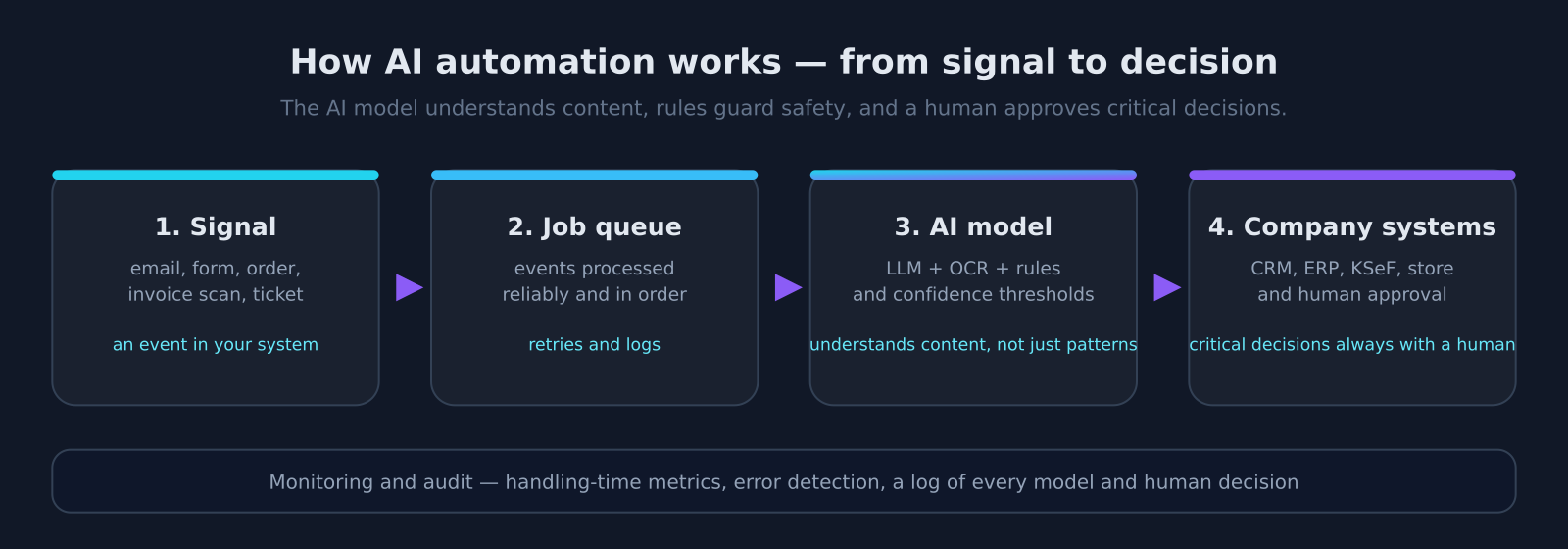
Classic automation runs on hard rules: “if the order is paid, issue an invoice”. AI automation goes further — it handles unstructured data that rules cannot: email content, scanned invoices, ticket descriptions or call recordings. A language model understands context, classifies, summarises, extracts data and makes decisions within defined boundaries, while you decide what it may do on its own and what requires human approval. In practice the best implementations combine both worlds: deterministic rules where reliability is critical (payments, accounting documents) and AI where human judgement used to be required (lead qualification, answering enquiries, document analysis). AI is not a goal in itself — the goal is a process that runs faster, cheaper and without errors.
AI automation in practice — the processes we automate most often
AI automation delivers the fastest results on processes that are repetitive, consume many team hours every week and rely on data you already have in your systems. In practice AI is used in sales and CRM, customer service, accounting, e-commerce operations, HR and marketing — and these are exactly the areas where AI automation pays back quickest. Instead of starting with technology, we start with a process map: where delays occur, where data is retyped by hand, and which tasks can be described with rules versus which need a model.
Sales and CRM — leads, quotes, follow-ups
Lead qualification and scoring from form and email data, automated quotes and calculations, follow-up reminders, customer history summaries before a call and CRM updates without manual retyping. An AI assistant can prepare a draft quote that the salesperson simply approves.
Customer service — email, tickets, chatbot and voicebot
Ticket classification and routing, automatic answers to repetitive questions (order status, availability, terms), long-thread summaries, a website chatbot and a voicebot handling your phone line outside business hours. Everything with escalation to a human when the case is non-standard or the customer asks for one.
Accounting and finance — invoices, OCR, KSeF
Reading invoices and documents (OCR + LLM), posting to the accounting system, KSeF e-invoicing compliance, payment reconciliation, periodic statements and reports. AI extracts data from documents while rules and validations guard accuracy — so accounting works on verified data.
E-commerce and operations — orders, stock, marketplaces
Order and stock synchronisation between store, marketplaces and ERP, automated invoices and shipping documents, product description generation and translation, returns and complaint handling, alerts for unusual events (e.g. an order spike on a low-stock product).
HR and recruitment — CVs, screening, onboarding
Automated CV analysis and matching against requirements, initial candidate qualification, interview scheduling, job description generation and onboarding checklists. The HR team gets a shortlist of best-fit candidates instead of hundreds of CVs to read.
Marketing and reporting — content, campaigns, dashboards
Content generation and variant testing (product descriptions, posts, newsletters), marketing reports combining Google Ads, GA4 and store data, automatic alerts about anomalies in campaigns and costs. Data from many sources lands in one dashboard instead of hand-built spreadsheets.
AI agents and AI assistants — digital workers in your company
An AI assistant answers and suggests: it knows your company documents, customer history and procedures, and the team asks it things that would otherwise take hours to find. An AI agent goes further — it performs multi-step tasks on its own: takes a ticket, checks data in your systems, prepares a document, sends it for approval and tracks the deadline. I build both on large language models (LLMs) with RAG: the model is not “trained” on your data; it retrieves from your company knowledge base at answer time — data stays in your infrastructure and answers are grounded in your documents, not the model’s guesses. Every agent operates within defined boundaries: what it may do alone, when it must ask a human and which events it writes to the audit log. Examples from real projects: a purchasing assistant answering in several languages, an agent qualifying tickets and routing them to the right people, a system analysing inbound documents and generating statements according to business rules.
Marketing automation and CRM automation with AI
Marketing automation sends the right message at the right moment: lead scoring from behaviour, automatic segmentation, personalised email sequences, abandoned-cart and reactivation campaigns, and reporting that pulls data from Google Ads, GA4 and your store into one dashboard. Classic marketing automation runs on rigid “if this, then that” rules; with AI it also generates content variants, predicts which leads are worth a salesperson’s time and flags anomalies in campaigns before the budget burns. CRM automation takes the admin work off the sales team: every enquiry, call and form lands in the CRM without retyping, meeting notes turn into deal summaries, the assistant suggests the next step and drafts follow-ups for approval. The effect compounds: a cleaner CRM means better lead scoring, and better scoring means marketing spends where it actually converts. If you run e-commerce, the same engine feeds product recommendations, review summaries and automatic responses to repeated questions.
What results does AI automation deliver? Metrics and ROI
Every project starts with the numbers we want to move — otherwise it is impossible to say whether automation works. The metrics that matter in practice: hours saved per week (the cost of manual handling), error rate and corrections (rework, duplicates, missed documents), handling time per case (first response, resolution), and cost per case (people, tools, licences). For a typical office process the pilot shows results within 1–3 weeks: 40–70% less manual handling on the automated step, errors close to zero on rule-guarded paths, and the team redeployed to exceptions instead of retyping. The payback calculation is simple: cost of the manual process (cases per month × minutes per case × fully loaded cost per minute) versus the build cost plus 10–20% yearly maintenance — most single-process projects pay back within a few months. I measure the baseline before the pilot and report the delta after, so the ROI is documented, not estimated. Results from client projects: 50% less time on administrative work in a CRM application with a client portal, and 40% shorter order handling after an omnichannel integration — the case studies below describe the numbers in detail.
RPA, AI automation and AI agents — what is the difference?
RPA (robotic process automation) mimics clicks and data entry between systems — great for stable, rule-based processes, but it fails when data is unstructured or the interface changes. AI automation is built on understanding content: it classifies emails, reads documents, summarises and makes context-based decisions. AI agents combine both: they plan multi-step tasks, use tools (APIs, databases, email) and execute them autonomously within limits you set. In practice these approaches complement each other — the table below shows when to choose which. I cover the differences in more depth in the article about business process automation.
AI automation tools — n8n, Make, Zapier, OpenAI API, LangChain
I do not lock projects into a single tool — I pick what fits the process, budget and security requirements. For fast integrations and workflows without building an application I use n8n, Make.com (formerly Integromat) and Zapier; for tailor-made solutions — the OpenAI API (GPT models, the same family behind ChatGPT) and LangChain with a Laravel or Python backend. Wherever data is sensitive, I favour open-source models running on your own infrastructure or in the EU cloud. If your company runs Microsoft 365, Power Automate and Excel-based reports are often the natural starting point. The outcome is the same: the process runs, it is monitored, and it does not depend on one subscription — you receive the export and documentation with the delivery.
Security, GDPR and the AI Act — how we implement AI lawfully
AI adoption must be secure and lawful — that is a requirement, not an add-on. I design with GDPR in mind: data minimisation, processing agreements with model providers, no customer data sent to public models without a legal basis and a record of processing operations. I apply technical safeguards: encryption, pseudonymisation, access limits, audit logs and test environments on anonymised data. Compliance with the EU AI Act (Regulation 2024/1689) is checked at design time: we classify the use case, document how it works and keep human oversight over decisions that require it. Your team gets a library of vetted prompts and an incident-reporting procedure so AI works repeatably and safely.
Python and C# in automation
For tasks beyond PHP I use Python (data analysis, machine learning, web scraping, document processing) and C# (Windows applications, hardware integrations). I connect them with Laravel through APIs or queues (RabbitMQ, Redis), building one coherent ecosystem: store and CRM in PHP, models and data analysis in Python, label printers or scanners in C# — all flowing through a single, monitored integration layer.
How much does AI automation cost?
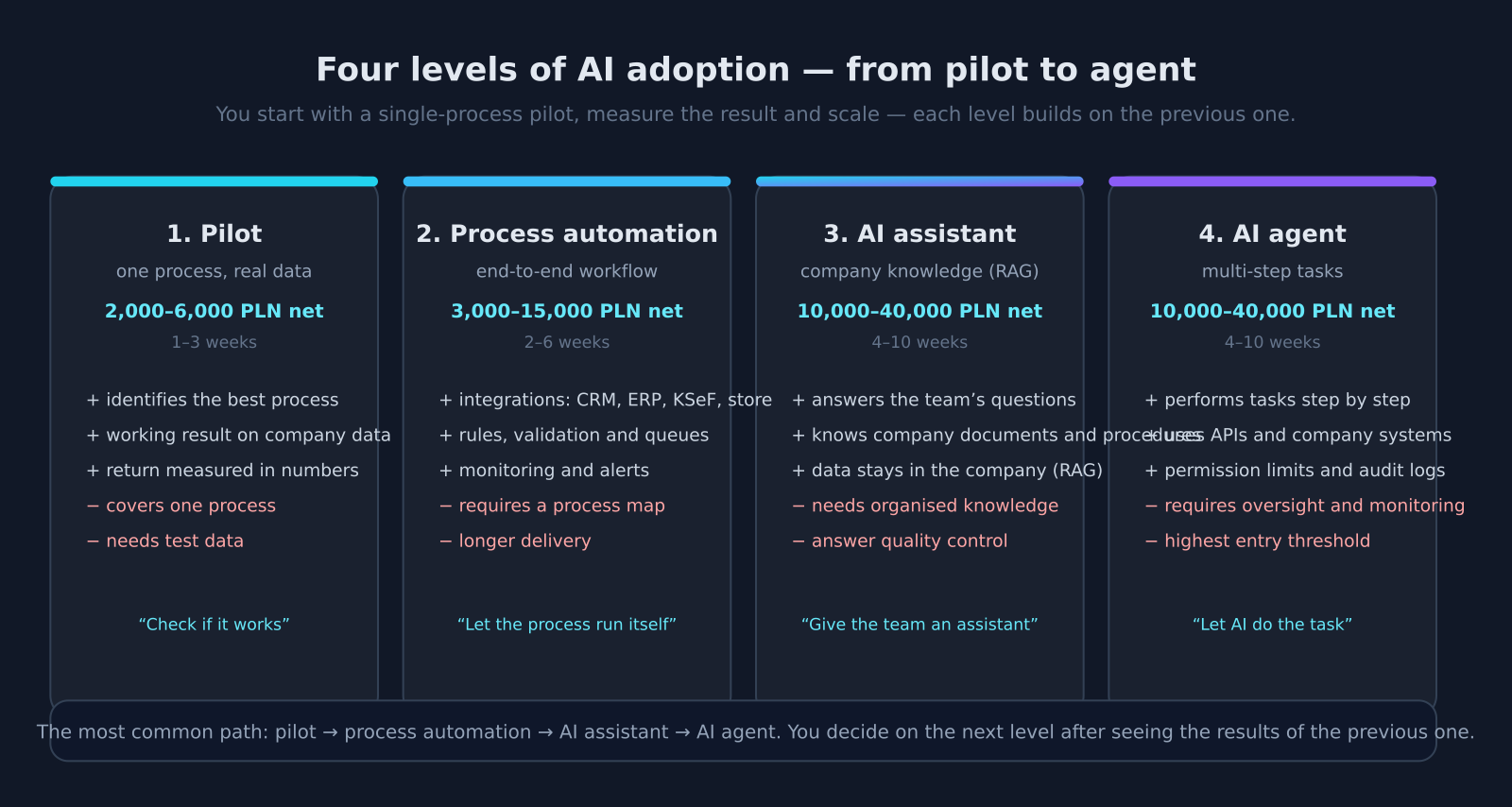
A single-process pilot is typically 2,000–6,000 PLN net and 1–3 weeks of work. End-to-end process automation (workflow with integrations, validation and monitoring): 3,000–15,000 PLN net. An AI assistant with company knowledge (RAG) or an agent performing multi-step tasks: 10,000–40,000 PLN net, depending on the number of integrations and security requirements. On top of that comes maintenance — usually 10–20% of the project value per year (models, infrastructure, development). The most common mistake is automating a process you cannot measure first — so every project starts with a workshop and a process map. Full ranges and project levels are described in the article on AI implementation cost.
Packages and rates
Four levels of engagement — from a workshop and pilot to ongoing automation development. Every stage has a fixed price and a measurable outcome; you decide on the next step after seeing the results of the previous one.
Workshop and AI pilot
2,000–6,000 PLN net
1–3 weeks
Process workshop, choosing the best automation candidate, a working pilot on real data, effect measurement (hours, errors, cost) and a recommendation for next steps.
Process automation (workflow)
3,000–15,000 PLN net
2–6 weeks
End-to-end automation: CRM, ERP, store and KSeF integrations, rules and validation, queues, error handling, monitoring and alerts. Fixed price after scope analysis.
AI assistant / AI agent
10,000–40,000 PLN net
4–10 weeks
An assistant with company knowledge (RAG) or an agent performing multi-step tasks: ticket qualification, document handling, quoting. With permission control, logs and GDPR compliance.
Automation care and development
from 1,500 PLN net/month
monthly retainer
Runtime monitoring, prompt and rule tuning, further processes, model updates and team support. Your automations evolve with the business.
How we work, step by step
A 6-step delivery — from workshop to scaling. You start with a pilot on a single process, see the numbers and only then decide on further automation.

Workshop and process audit
We map processes, count hours and costs and shortlist automation candidates. Output: a process list with ROI and risk estimates.
Pilot selection and design
We pick one process with the best effect-to-risk ratio. Technical design: integrations, model, autonomy boundaries, success criteria.
Prototype build
A working prototype on real data: workflow, prompts, agent or assistant. A mid-stage demo — you see the result before paying for the whole project.
Testing and security
Tests on company data, edge cases, hallucination control, GDPR and AI Act compliance. We define what AI does autonomously and what needs approval.
Rollout and team training
Production rollout with monitoring and alerts, documentation, team training and a prompt library. Your team knows how to use and extend the tool.
Monitoring, metrics and next processes
We measure the effect (hours saved, errors, handling time), tune performance and automate further processes. Growth in stages, not one big project up front.
Contract, security and code ownership
Pilot before scale
You do not start with a big project. First a working pilot on one process, effect measured in numbers, then a decision on what to automate next.
Data stays in your company
Solutions are designed so customer data never goes to public models without a legal basis. Open-source models on your infrastructure, EU cloud, processing agreements and audit logs.
Code and knowledge stay with you
Workflows, prompts, integrations and documentation go into your repository. No lock-in to one tool or subscription — the solution must work without me too.
Staged billing
Every stage has a fixed price and acceptance criteria. After the pilot you can continue, change scope or stop — with no commitment to the whole programme.
Comparison
Four approaches to automation — cost, risk and control. The best answer is usually a mix: RPA and rules for critical processes, AI for unstructured data, agents where autonomy is needed.
| Model | Best for | Cost | Risk | Control |
|---|---|---|---|---|
| Manual work | Rare and creative processes — where automation does not pay off | hidden: team hours and retyping errors | High: turnover, holidays, growing volume | Full, but expensive |
| RPA (rules and macros) | Stable, rule-based processes between systems without APIs | 3,000–20,000 PLN + maintenance | Medium: sensitive to interface changes and exceptions | High — fully deterministic behaviour |
| AI automation (workflow + LLM) | Unstructured data: emails, documents, tickets | 3,000–15,000 PLN + 10–20% per year | Low: validation, confidence thresholds, human approval | High — rules + model within defined boundaries |
| AI agents | Multi-step decision tasks: sales, service, operations | 10,000–40,000 PLN + care | Medium: requires permission limits and monitoring | Medium — the agent acts autonomously within set boundaries |
Market rate comparison
Public price lists of selected providers (10.2026).
| Provider | Rate | Note |
|---|---|---|
| Website AI chatbot (market) | from 3,000 PLN | Standard build on a ready API, without integration with company systems |
| Process automation / workflow (market) | 5,000–15,000 PLN | Public price lists of automation agencies (e.g. mkmlabs.pl, 10.2026) |
| AI assistant with company knowledge (RAG) | 15,000–40,000 PLN | Projects with CRM/ERP integration and data access control |
| Production AI agent | from 30,000 PLN | Multi-step tasks, permission limits, monitoring and audit |
Indicative ranges based on public price lists of providers in Poland (as of 10.2026). The actual cost depends on the number of integrations, data quality and security requirements — every quote is preceded by a free scope analysis.
Technology stack
Legal basis and standards
Related services
- E-commerce & API integrations A prerequisite for automation — data must flow between systems.
- Laravel development The applications and panels automations run in.
- Legacy PHP modernization Cleaning up systems before automating them.
- Technical care and SLA Monitoring and support for automations after launch.
- Topic hub: process automation and AI — guides Project costs, data security, practical prompts and step-by-step process automation.
- How much does AI implementation cost? Three project levels from 3,000 to 150,000 PLN net and 10–20% yearly maintenance.
- AI in your company: practical prompts and data security How to adopt AI without data leaks and team chaos.
- Case study: CRM application and client portal 50% less time on administrative work — team workflow automation.
- Pricing Packages, engagement models and hour blocks.
Worth reading
- How much does AI implementation cost? Pricing and project levels [2026] Three project levels from 3,000 to 150,000 PLN net, what drives the price and when AI does not pay off.
- AI automation for small business — where to start and what it costs [2026] A pilot from 2,000 PLN net, which processes to automate first and how to start in 3 steps.
- AI automation agency — what it does and how much it charges [2026] Scope of work, market pricing, a partner-selection checklist and red flags to watch for.
- Marketing automation with AI — what changes and what it costs [2026] Content generation, lead scoring, personalisation and campaign anomaly alerts.
- Business process automation — what it is and where to start How it differs from digitalisation and AI, which processes to automate first and how to calculate ROI.
- AI in your company: practical prompts and data security How to adopt AI without data leaks and team chaos.
- Designing resilient API and webhook integrations Queues, retries and monitoring — the foundation of reliable automation.
FAQ
What is AI automation?
AI automation uses artificial intelligence (large language models, machine learning, OCR) to perform work that used to require people: understanding email content, analysing documents, classifying tickets and making decisions within defined boundaries. Unlike classic rule-based automation, AI automation handles unstructured data.
Which processes can I automate?
Most often we automate: email and ticket handling, invoicing and accounting documents (OCR, KSeF), lead qualification and quoting, order and stock synchronisation between store, marketplaces and ERP, CV analysis in recruitment, marketing reporting and content generation. We start with the process that consumes the most hours and is the most repetitive.
How much does AI automation cost?
A single-process pilot: 2,000–6,000 PLN net (1–3 weeks). End-to-end process automation: 3,000–15,000 PLN net. An AI assistant with company knowledge (RAG) or an AI agent: 10,000–40,000 PLN net. Maintenance is usually 10–20% of the project value per year. The exact price comes after a free scope analysis — no hidden costs.
Is AI automation GDPR-compliant?
Yes — I design projects compliant with GDPR and the EU AI Act. In practice: data minimisation, processing agreements with model providers, no customer data sent to public models without a legal basis, open-source models on your infrastructure where required, audit logs and human oversight of critical decisions.
How is AI automation different from RPA?
RPA (robotic process automation) mimics clicks and data entry under hard rules — it works well for stable processes but does not understand content. AI automation understands unstructured data: it classifies emails, reads invoices, summarises and makes context-based decisions. In practice the two combine best: rules for critical processes, AI for tasks that require understanding.
Will AI agents replace employees?
Not in the way the market fears. AI agents take over repetitive, time-consuming tasks: retyping data, initial classification, preparing documents — while the team focuses on work that needs relationships and judgement. In practice, AI adoption increases team throughput (the same people handle more cases) rather than reducing headcount.
Where should I start with AI adoption?
With a workshop and a process map: we count hours, costs and errors in repetitive tasks and pick one process for a pilot. The pilot takes 1–3 weeks, runs on real data and has defined success criteria (e.g. 50% faster ticket handling). Only after the measured result do we scale to further processes.
Can AI work on my company data?
Yes — that is when it delivers the most value. Assistants built with RAG are not “trained” on your data; the model retrieves from your company knowledge base at answer time and the data stays in your infrastructure. Documents, procedures and customer history never leave the company, and every access is logged.
How long does an AI automation project take?
A single-process pilot: 1–3 weeks. End-to-end process automation with integrations: 2–6 weeks. An AI assistant or agent integrated with CRM/ERP: 4–10 weeks. After the first delivery, further processes go faster because the integrations and the security layer already exist.
Which models and tools do you use?
I match tools to the task, data and budget: the OpenAI API (GPT) for generative tasks, open-source models (e.g. Llama, Mistral) when data cannot leave your infrastructure, n8n, Make.com, Zapier and Power Automate for workflows, LangChain for building assistants and agents, Python for data analysis and OCR. The solution is not locked to one vendor — documentation and export stay with you.
What are the types of AI automation?
In practice there are four levels: (1) rule-based workflow automation with AI steps — e.g. an invoice is read by OCR and posted by rules; (2) process automation end to end — a workflow with integrations, validation and monitoring; (3) an AI assistant with company knowledge (RAG) that answers and suggests using your documents; (4) an AI agent that performs multi-step tasks on its own within defined boundaries. Most companies start at level 1–2 and grow into assistants and agents where the process justifies it.
What is the 30% rule in AI projects?
A common budgeting heuristic: at most ~30% of an AI project budget should go to the technology itself (models, licences, infrastructure), while the remaining ~70% goes to data preparation, integrations, process design, security and change management. Projects that invert this ratio — buying tools first — usually stall at the pilot stage. A related rule of thumb: budget the first project so that a failed pilot costs no more than 30% of what a full deployment would.
Is RPA outdated?
No — but its role changed. RPA still works well for stable, rule-based processes between systems without APIs (legacy software, desktop applications). What changed is the default: where content understanding is needed (documents, emails, tickets), AI automation does the job with less fragility. The best implementations combine both: deterministic rules where reliability is critical, AI where human judgement used to be required.
What does an AI automation agency do?
An AI automation agency maps your processes, picks the ones with the best effect-to-risk ratio, builds the automations (workflows, integrations, assistants, agents), integrates them with your systems (CRM, ERP, store, accounting) and then monitors and develops them. At informatix every engagement starts with a workshop and a pilot on one process — you see measured results before committing to a larger programme.
How much do AI automation agencies charge?
In Poland (10.2026): a website chatbot from 3,000 PLN, process automation/workflow 5,000–15,000 PLN, an AI assistant with company knowledge (RAG) 15,000–40,000 PLN, a production AI agent from 30,000 PLN. At informatix: pilot 2,000–6,000 PLN net, process automation 3,000–15,000 PLN, assistant/agent 10,000–40,000 PLN, plus 10–20% of project value per year for maintenance. Every quote follows a free scope analysis.
How can a small business start with AI automation?
Start with one repetitive process that consumes hours every week and uses data you already have — typically email/ticket handling, invoicing, quoting or order processing. Run a pilot (1–3 weeks, from 2,000 PLN net): measure the baseline, automate one step, compare the numbers. If the pilot pays back, scale to the next process using the integrations and security layer you already built. Small businesses often see the fastest wins in customer service and back-office documents.
Krzysztof Słonina
Senior full-stack developer, owner of Inoventis Solutions
16 years in PHP/Laravel, e-commerce integrations and process automation. Builds AI assistants and agents integrated with CRMs, ERPs and stores — from prompt engineering to production queues, monitoring and GDPR compliance. Author of AI posts on the informatix blog.
Results from real projects
CRM application and client portal
50% less time on administrative work
Read the case studyPHP application modernization
Zero critical incidents for 12 months
Read the case studyIndicative ranges for this service: see pricing
Web app requirements checklist
12 control questions to answer before talking to a vendor — faster estimates, fewer hidden costs.
Want to automate your business processes?
Let us start with a free analysis: I will point out the 2–3 processes worth automating first and estimate the expected return. No commitments, no technical jargon.
Get started