Service
PrestaShop Development Services — B2C & B2B Stores
PrestaShop store builds, custom module and theme development, integrations and performance optimisation — from analysis to post-launch support.
PrestaShop development services cover the full lifecycle of an online store: builds, custom module and theme development, integrations, performance optimisation, migrations and ongoing maintenance — delivered directly by a developer with 16 years of e-commerce experience. PrestaShop is a mature e-commerce platform offering full store ownership and no sales commission. I have worked with it for years: building new stores, extending existing ones, writing and modifying modules, and connecting PrestaShop with marketplaces, carriers and ERP systems. I know where the platform is strong and where it needs optimisation so you do not lose customers in the checkout. I build B2C and B2B stores — from simple ready-template builds to advanced wholesale platforms with individual pricing.
Last updated: 26.10.2026
Budget range
2,500 – 40,000 PLN
Final fixed price after a free scope analysis — no hidden costs.
What is PrestaShop and when to choose it
PrestaShop is an open-source e-commerce platform powering over 280,000 online stores worldwide — from small shops to advanced B2B platforms with catalogues of tens of thousands of products. You choose it when you want full ownership of the store and its data, no sales commission and the freedom to extend features through modules. It is a strong fit for stores with large catalogues, B2B sales with individual pricing and businesses that need non-standard processes — ERP, warehouse or marketplace integrations. It is a weaker choice when all you need is the fastest possible launch without technical resources — SaaS platforms are simpler then.
How a PrestaShop build runs — 7 stages
I run PrestaShop builds in seven stages: 1) analysis and specification — assortment, sales channels (B2C/B2B/marketplace), required integrations and legal requirements (Omnibus, GDPR, EAA); 2) UX/UI design — information architecture, product page, cart and conversion-focused checkout; 3) platform configuration — PrestaShop 8.x/9.x installation, theme, taxes, currencies, shipping zones and legal content; 4) integrations — payments (Przelewy24, PayU, Stripe), carriers (InPost, DHL, DPD), invoicing, ERP and Allegro; 5) data migration — products, categories, customers and orders with field mapping and 301 redirects; 6) testing — full checkout path, sandbox payments, transactional emails, performance; 7) go-live and team training. A simple store launches in 2–3 weeks, a custom-design build in 4–8 weeks, and an advanced platform with integrations in 2–4 months. Every stage ends with a demo for acceptance, so you see progress and can adjust direction before the whole thing is finished.

How much does a PrestaShop build cost
A PrestaShop store build costs 2,500–40,000 PLN net depending on scope and integrations. The PrestaShop software itself is free — you pay only for the work. A build on a ready-made template with basic payments and shipping is 2,500–6,000 PLN net. A store with custom visual design and dedicated modules is 6,000–15,000 PLN net. An advanced platform with Allegro, ERP and multi-channel sales integrations is 15,000–40,000 PLN net and up. On top of that come fixed costs: hosting 100–400 PLN per month, commercial modules 200–2,000 PLN one-off and technical care from 400 PLN net per month. I quote after a scope workshop, in stages — no hidden costs and no paying for features you do not need.
New build or taking over an existing store?
A new store starts with environment configuration and catalogue structure, then template, payments and shipping, and finally checkout testing and go-live. When taking over an existing store I start with a technical audit: PrestaShop and PHP version, module health, database performance, security, structured data correctness and facet indexation settings. Only then do we plan growth — extending a store with technical debt usually just produces more bugs.
Custom module and theme development for your processes
I provide custom module development and theme development when off-the-shelf solutions do not cover the process — these customization services cover non-standard pricing and discounts, B2B orders with approval, shipping cost calculation on your own rules, data imports and exports, warehouse system integrations. I also handle customisation of existing modules and templates — theme modifications go into child themes, so updates do not wipe the changes. Every change goes to a staging environment first, with a database and file backup.
PrestaShop for B2B — wholesale and company-account sales
PrestaShop handles B2B sales as well as B2C. I implement: individual price lists assigned to customer groups, trade credit with limits and payment terms, sub-accounts for branches and purchasing departments, saved carts and quick reorders from history, VAT invoices and deferred payments. I connect the store with the warehouse system and ERP so stock and wholesale prices update automatically and B2B orders flow straight into the sales process. Most B2B stores start with a B2C base — the platform grows with the wholesale channel, without rewriting from scratch.
Integrations that earn: Allegro, InPost, Przelewy24, ERP and CRM
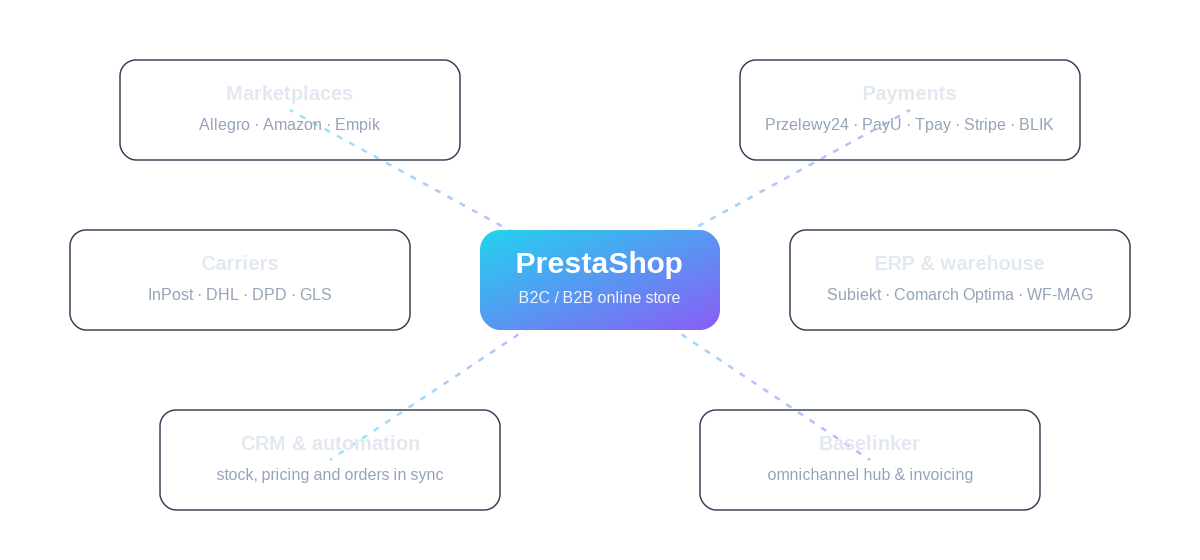
Allegro integration — listing offers, synchronising stock and prices, pulling orders and automatic shipment confirmation. Shipping — InPost, DHL, DPD and GLS with label generation and tracking passed to the customer. Payments — Przelewy24, PayU, Tpay and Stripe with BLIK and buy-now-pay-later. Baselinker as an omnichannel hub when you sell across several channels at once. Plus ERP, CRM and accounting systems so invoices issue themselves, and workflow automation — including AI tools for product data processing — that keeps stock, pricing and orders in sync.
PrestaShop performance optimisation services
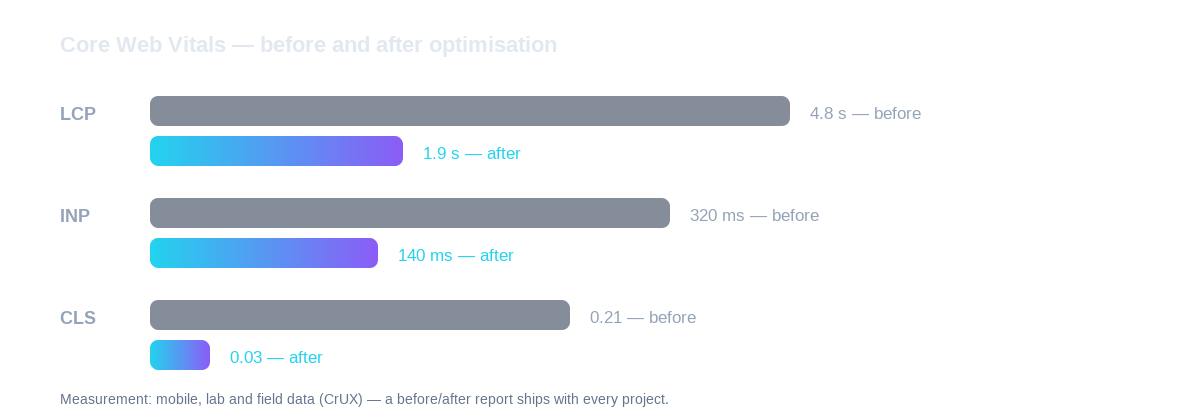
PrestaShop performance optimisation is a layered process — from server and cache configuration, through images and scripts, down to modules running heavy queries on every request. PrestaShop can be fast, but the default configuration does not make it so. I optimise layer by layer: server and Smarty cache, template compilation, database cache and Redis, WebP image conversion, lazy loading, fewer external scripts and a clean analytics setup. I also check which modules run heavy queries on every request — the most common cause of a slow store. I measure the result on Core Web Vitals: LCP under 2.5 s on mobile.
One-page checkout and conversion
Every extra checkout step is a lost order. I implement a streamlined one-page checkout with delivery details and payment on a single screen, real-time field validation and mobile handling. I also tidy the buying path: clear shipping costs already in the cart, visible delivery time, field hints and abandoned cart handling. Every change is measured — before and after — so we know it actually works.
PrestaShop migration services — 1.6 and 1.7 to 8.x/9.x
I run migrations from PrestaShop 1.6 and 1.7 to 8.x and 9.x, plus PHP upgrades to supported versions. Migration covers products, customers, orders, categories, content and module configuration, preserving URLs and adding 301 redirects so you do not lose Google positions. The whole process runs on a copy of the environment with comparative tests before traffic is switched. The old store keeps running until the new one is fully verified.
PrestaShop maintenance and support services after launch
A store is a system that needs maintenance: PrestaShop and module updates, security patches, backups, uptime and performance monitoring, ongoing bug fixes and growth with new features. I offer monthly maintenance and support packages with a guaranteed response time, plus per-task billing for larger changes. Every update is preceded by a backup and changes go through staging — the production store is not an experiment.
Why work with dedicated PrestaShop experts
You work directly with the developer who writes the code — Krzysztof Słonina, a full stack developer with 16 years of experience in e-commerce and 120+ delivered projects. My e-commerce expertise covers module development, theme customisation, migrations and integrations. Unlike large development companies, there are no account-manager layers and no handovers between teams — the PrestaShop experts and developers you talk to are the ones doing the work. Every project starts with a free consultation where we review your store, integrations and a growth plan with a realistic budget. The code, themes and store data remain your property — after launch you can continue with a care plan or take the project in-house.
Packages and rates
Three typical scopes — from a starter store to a B2B platform with integrations. Each is quoted at a fixed price after a free scope analysis.
Ready-template store build
2,500 – 6,000 PLN net
PrestaShop 8.x/9.x configuration, template, payments, shipping, legal content, checkout tests and go-live. Launch in 2–3 weeks.
Custom-design store
6,000 – 15,000 PLN net
Bespoke UX/UI, dedicated modules, performance and checkout optimisation for conversion. Delivered in 4–8 weeks.
B2B platform with integrations
15,000 – 40,000 PLN net and up
Individual price lists, trade credit, ERP, Allegro, Baselinker and multi-channel sales. 2–4 months.
Technology stack
Legal basis and standards
Related services
- E-commerce store development Platform comparison and the full e-commerce delivery scope.
- E-commerce & API integrations Allegro, Baselinker, ERP, payments and carriers.
- Legacy PHP modernization Updates, security and store care.
Worth reading
- PrestaShop vs WooCommerce vs Shopify — 3-Year TCO Cost comparison across three platforms with numbers: build, subscriptions, commissions, maintenance.
- Express Checkout in PrestaShop — faster orders Buy Now button, one-click payments and one-page checkout — how to shorten the purchase path.
- Building a PrestaShop online store — full guide Implementation, modules, payments and shipping step by step.
- PrestaShop implementation — how a project runs Project stages, staging environments and store acceptance.
- PrestaShop performance optimisation Cache, images, modules and Core Web Vitals in practice.
- InPost in PrestaShop — parcel lockers and shipping Locker map, ShipX API, labels, tracking and integration costs.
- PrestaShop Migration Services — 1.6 & 1.7 to 8.x/9.x Process, checklists, risks and costs of migrating a PrestaShop store without losing SEO.
- PrestaShop Maintenance Services — Care Plans & Support Updates, backups, monitoring, security and response times — care plans compared.
FAQ
How much does a PrestaShop store cost?
A build on a ready-made template with basic payments and shipping is 2,500–6,000 PLN net. A store with custom design and dedicated modules 6,000–15,000 PLN. An advanced store with Allegro, ERP and multi-channel sales integrations 15,000–40,000 PLN and up. I quote after a scope analysis, and monthly care starts at 400 PLN net.
How long does a PrestaShop build take?
A ready-template store launches in 2–3 weeks. A build with custom visual design takes 4–8 weeks. A store with Allegro, ERP and multiple sales channels takes 2–4 months. Gathering product content and agreeing shipping and payment rules is usually the longest stage — which is why I start with a scope workshop.
Can you integrate the store with Allegro and Baselinker?
Yes. Allegro integration covers listing offers, synchronising stock and prices, pulling orders and automatic shipment confirmation. I deploy Baselinker as an omnichannel hub when you sell simultaneously through several channels — your store, Allegro, Amazon and Empik. Synchronisation runs both ways and also covers stock levels and invoicing.
Can you migrate from PrestaShop 1.7 to 8.x?
Yes. Migration covers products, customers, orders, categories, content and module configuration, preserving URLs and adding 301 redirects. I work on a copy of the environment with comparative tests before switching traffic. The old store keeps running until the new one is fully verified, so you do not lose sales during the migration.
My store loads slowly — can it be fixed?
In most cases yes, and it is usually the fastest route to higher conversion. I optimise Smarty and server cache, enable Redis, convert images to WebP, limit external scripts and hunt down modules running heavy queries on every request. I measure the result on Core Web Vitals before and after, rather than claiming it.
Will you take over a store from a previous contractor?
Yes. I start with a technical audit: PrestaShop and PHP version, module health, database performance, security and structured data configuration. I also verify access and code ownership. Then I clean up the environment, fix bugs and move to ongoing development and care — without rewriting the store from scratch unless it is truly necessary.
What is PrestaShop and who is it for?
PrestaShop is an open-source e-commerce platform powering over 280,000 stores worldwide. It is a good choice when you want full ownership of the store and its data, no sales commission and the freedom to extend features. It fits stores with large catalogues, B2B sales with individual pricing and businesses that need non-standard integrations — ERP, warehouse, marketplace.
PrestaShop or WooCommerce — which to choose?
Choose PrestaShop when performance with a large catalogue (10,000+ products), advanced B2B sales and no commission matter most. WooCommerce makes sense when the store is part of a WordPress content ecosystem and the budget is smaller. I cover the detailed comparison — cost, performance, B2B and migrations — in the guide [PrestaShop vs WooCommerce](/en/blog/prestashop-vs-woocommerce).
Is PrestaShop free?
Yes — PrestaShop software is open source with no licence or sales commission. You pay only for the build (work), hosting (100–400 PLN/month), optional commercial modules (200–2,000 PLN one-off) and technical care (from 400 PLN/month). Your entire budget goes into developing the store rather than a platform subscription.
What does PrestaShop do?
PrestaShop is an open-source e-commerce platform used to run online stores: it handles product catalogues, carts and checkout, payments (Przelewy24, PayU, BLIK, Stripe), shipping (InPost, DHL, DPD), invoices, customer accounts and B2B pricing. Through modules and API integrations it also connects the store to marketplaces (Allegro, Amazon), ERP and warehouse systems — which makes it a complete sales hub for a business rather than just a storefront.
Is PrestaShop better than Shopify?
PrestaShop is better when you want full ownership of the store and its data, no sales commission, deep customisation through modules and integrations with Polish and European systems (Allegro, Baselinker, Przelewy24, ERP). Shopify is better when you prefer a fully hosted SaaS with no server maintenance and accept subscription fees and transaction commissions. I compare the three-year TCO of PrestaShop, WooCommerce and Shopify in the guide [PrestaShop vs WooCommerce vs Shopify](/en/blog/prestashop-vs-woocommerce-vs-shopify).
Is PrestaShop legit and secure for an online store?
Yes — PrestaShop is a mature open-source platform used by over 280,000 stores, with regular security releases and a large module ecosystem. Store security depends on maintenance: keeping the core and modules updated, running a supported PHP version, backups with a restore test and server hardening. As part of my care plans I run updates on staging before production and monitor security continuously.
Do you offer PrestaShop maintenance and support services?
Yes. Maintenance and support services cover PrestaShop and module updates, security patches, backups, uptime and performance monitoring, bug fixes and ongoing development, with monthly packages and a guaranteed response time (first response within 4 hours for sales-blocking outages). For ad-hoc problems there are hourly packages and diagnostics with a report — see the [PrestaShop technical help](/en/services/prestashop-technical-help) page.
Results from real projects
Omnichannel integration
Order handling time cut by 40%
Read the case studyCRM application and client portal
50% less time on administrative work
Read the case studyIndicative ranges for this service: see pricing
Web app requirements checklist
12 control questions to answer before talking to a vendor — faster estimates, fewer hidden costs.
Running a PrestaShop store?
Book a free call — we will review store speed, integrations and a growth plan with a realistic budget.
Book a call