Service
E-commerce Store Development
Stores that sell — from strategy and UX to payments, shipping, SEO and ongoing growth.
I design and build online stores for companies that want to sell online without compromises — from WooCommerce, PrestaShop and SaaS deployments to custom Laravel builds for unusual processes. Every project starts with analysing your assortment, audience and sales channels, and ends with a launch, integrations and a growth plan.
Budget range
1,500 – 50,000+ PLN
Final fixed price after a free scope analysis — no hidden costs.
E-commerce development services
A complete e-commerce development service for B2C and B2B businesses — from website development and UX through the store build, integrations and SEO, to long-term support. One partner for the entire project, whether you sell 50 products or 50,000 SKUs. Every engagement ends with a store your team can run — and a growth plan based on real data, not guesswork.
- New online stores and e-commerce websites — WooCommerce, PrestaShop, Shoper, Shopify and custom Laravel builds
- Store redesign and replatforming — migrations without losing SEO rankings or order history
- E-commerce integrations — payments, shipping, ERP, accounting, marketplaces and CRM
- Performance and Core Web Vitals — faster stores that turn more traffic into revenue
- Technical SEO and product feeds — category structure, schema.org data, Google Merchant Center
- Ongoing care — monitoring, updates, security and continuous conversion optimisation (CRO)
From strategy to launch
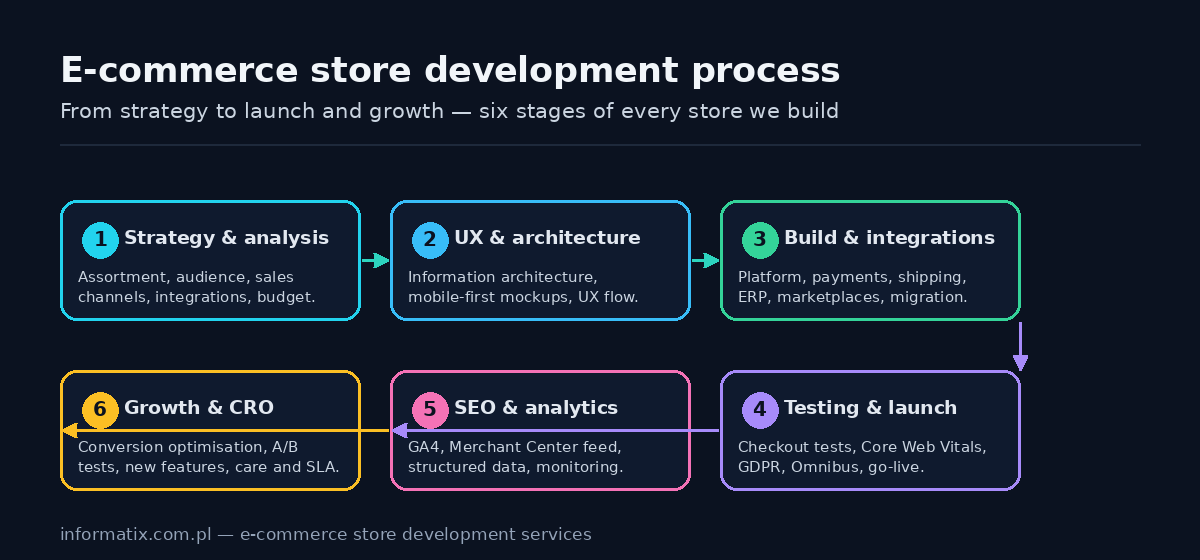
Workshop, information architecture, mobile-first mockups, implementation, payment and shipping setup, checkout testing and go-live. You get a store ready to sell.
How much does e-commerce store development cost?
The budget depends on the delivery model, the number of integrations and the size of the catalogue. Typical ranges for the European market (amounts in PLN net; a store built in Poland typically costs 30–50% less than a comparable quote from a Western European agency):
| Delivery model | Timeline | Cost (net) |
|---|---|---|
| Ready-made template (WooCommerce, Shoper, Sky-Shop) | 1–2 weeks | 1,500 – 2,800 PLN |
| Custom design on open source (WooCommerce, PrestaShop) | 3–6 weeks | 5,000 – 10,000 PLN |
| Store with ERP and marketplace integrations | 1–3 months | 15,000 – 50,000 PLN |
| Custom-built / headless store (Laravel + React) | 3–6 months | from 50,000 PLN |
Which e-commerce platform should you choose?
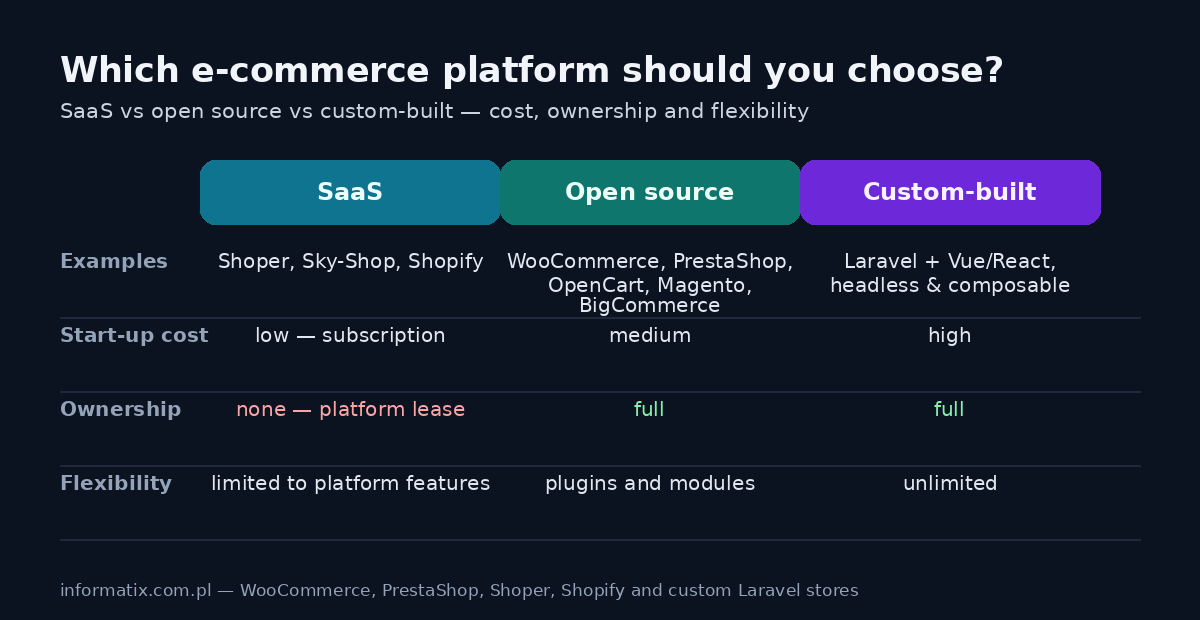
The platform follows the business model, not the other way around. During the free scope analysis I match your catalogue size, sales channels and growth plans to one of the e-commerce platforms below — including BigCommerce, Adobe Commerce (Magento) and headless / composable commerce architectures for larger operations.
| Platform | Best for | Notes |
|---|---|---|
| WooCommerce | Small and medium B2C stores | Lowest cost, full code ownership, huge plugin ecosystem |
| PrestaShop | Growing catalogues and B2B in Europe | Native multistore, mature B2B modules, ERP integrations |
| Shoper / Sky-Shop (SaaS) | Fast launch on a subscription | Low start-up cost, flexibility limited to the platform |
| Shopify | International D2C brands | Best-in-class checkout, app ecosystem, monthly fees |
| BigCommerce / Adobe Commerce | Large catalogues at scale | Enterprise features, higher total cost of ownership |
| Laravel + React (custom) | B2B, marketplaces, unusual processes | Unlimited flexibility, headless and composable architecture |
Integrations that work in the background
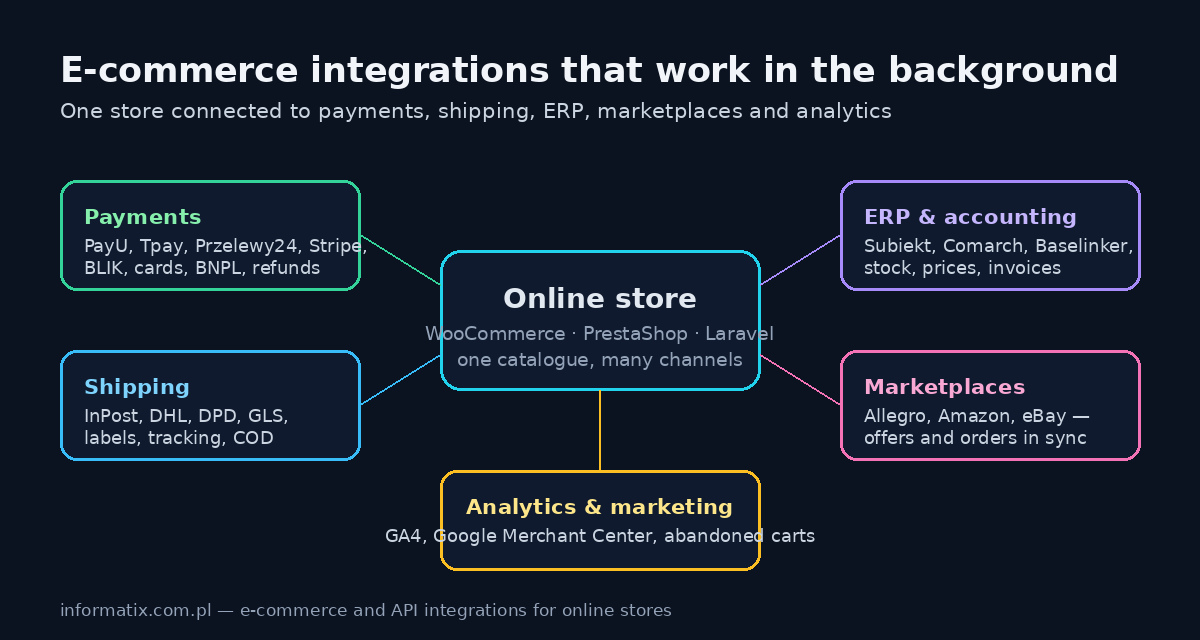
Payments — PayU, Tpay, Autopay, Przelewy24, Stripe, BLIK, cards and BNPL. Shipping — InPost, DHL, DPD, GLS via aggregators. ERP and marketplaces — Subiekt, Comarch, Baselinker, Allegro, Amazon. Plus accounting software, CRM and GA4 analytics. Every integration covers inventory and stock synchronisation, error handling and monitoring — so one failing system never stops sales.
Compliance and SEO
GDPR, the Omnibus Directive (30-day lowest price) and the European Accessibility Act (WCAG 2.1 AA). Technical SEO as standard — best practices for category structure, schema.org data, faceted navigation control, Core Web Vitals and a Google Merchant Center feed.
Features every store needs
Cart and checkout with the fewest possible steps, a customer area with order history and returns, order and inventory management in the admin panel, search with autocomplete and faceted filters, payment and refund handling, discount rules, and marketing tools — newsletters, abandoned carts and a Google Merchant Center feed. Every screen is responsive (RWD) and designed to build your brand and trust on mobile, where over 60% of Polish e-commerce orders are placed.
Performance and Core Web Vitals
A store that loads in four seconds loses customers before the first click. I design for Core Web Vitals from day one: WebP/AVIF images, lazy loading, cache, CDN, inline critical CSS and a limited number of third-party scripts. On Laravel I add Redis (cache, queues, sessions) so ERP synchronisation never slows the storefront down — LCP under 2.5 s on mobile and a stable layout (CLS), even during Black Friday traffic peaks.
B2B, B2C and hybrid models
B2C stores optimise for a fast checkout, BLIK, InPost lockers and BNPL. B2B adds per-customer price lists, credit limits, order approvals and invoice terms. I usually build a hybrid model: one catalogue, two buying flows and shared stock levels — without re-typing data between channels. The full playbook is in the B2B online store guide.
A senior team, 16 years in business
You work directly with the people who build your store — no account managers relaying messages, no rotating cast of junior developers. Since 2010 we have delivered web applications and online stores for clients in Poland and across Europe, and every project ships with documentation and a handover your team can rely on.
- 16 years of experience in web development and e-commerce
- Direct contact with the developers and the architect of your store
- Fixed price agreed after a free scope analysis — no hidden costs
- Code and infrastructure ownership stay with you
- Support in English and Polish, EU business hours
Care and growth after launch
Monitoring, updates, backups, conversion optimisation and new features — from additional integrations to AI automations. Retainer or task-based.
Technologies we use
Legal basis and standards
Related articles
- E-commerce website development — complete guide 2026 Costs, platforms, delivery stages, payments, shipping, GDPR and Omnibus in one place.
- B2B online store — how to launch a wholesale business online Customer-specific price lists, quick ordering, credit limits and ERP integration.
- Designing resilient API and webhook integrations Subiekt, Comarch, Baselinker — synchronisation without errors.
- E-commerce ERP integration Connecting your store to ERP and marketplaces without manual work.
Related services
- PrestaShop stores Builds, modules and 1.7 → 8.x migrations.
- WordPress maintenance & care Sites and stores on WordPress and WooCommerce.
- E-commerce & API integrations Connecting the store to marketplaces, ERP and carriers.
FAQ
How much does e-commerce store development cost?
From 1,500–2,800 PLN net for a ready-made template, through 5,000–10,000 PLN gross for a custom design on open source, to 15,000–50,000 PLN and more for a store with advanced ERP and marketplace integrations. I give a fixed price after a free scope analysis.
Which platform will my store be built on?
The recommendation follows an analysis of your assortment, sales scale and budget. I most often deploy WooCommerce and PrestaShop, configure SaaS platforms (Shoper, Sky-Shop, Shopify) and build custom Laravel solutions for unusual processes. Magento fits large catalogues, OpenCart simple builds.
How long does it take to build an online store?
A simple store on a ready-made template takes 1–2 weeks. A custom design on open source takes 3–6 weeks, and a store with ERP and marketplace integrations — 1–3 months.
Will the store comply with GDPR, Omnibus and the EAA?
Yes — compliance is part of the delivery: privacy policy and consents (GDPR), lowest price from the 30 days before a reduction (Omnibus), WCAG 2.1 AA accessibility (EAA) and technical SEO with structured data.
Can you build a B2B store with customer-specific pricing?
Yes. B2B stores run on WooCommerce, PrestaShop or Laravel: per-customer or per-group price lists, credit limits, volume discounts, bulk ordering and manager approval — all in one panel with shared stock for the B2C channel.
Can you take over a store built by another agency?
Yes. I start with a technical audit (performance, plugins, security, structured data), then clean up integrations and migrate without downtime. If the platform blocks growth, I plan a migration to WooCommerce, PrestaShop or Laravel — moving products, customers and order history.
What does an e-commerce developer do?
An e-commerce developer builds and maintains the technical layer of an online store: the storefront and checkout, the admin panel, integrations with payments, shipping, ERP and marketplaces, plus performance, security and SEO foundations. That also includes ongoing work — new features, bug fixes and conversion optimisation — so the store keeps growing after launch.
What are the top 5 e-commerce platforms in 2026?
By global market share: WooCommerce (WordPress), Shopify, BigCommerce, Adobe Commerce (Magento) and PrestaShop. For small and medium stores in Europe, WooCommerce and PrestaShop offer the best balance of cost and ownership; Shopify and BigCommerce are strong SaaS options for D2C brands; Adobe Commerce fits large catalogues. In Poland, Shoper and Sky-Shop are the leading SaaS platforms.
Is e-commerce still profitable in 2026?
Yes — but the margin increasingly depends on the technical quality of the store. With rising advertising costs, profitability comes from conversion rate, repeat purchases and automation. A fast, well-integrated store (Core Web Vitals, BLIK and BNPL payments, ERP synchronisation, abandoned cart recovery) typically converts 2–3 times better than a slow one, which is often the difference between profit and loss on the same traffic.
Shopify or a custom-built store — which should I choose?
Shopify fits international D2C brands that want a fast launch, a best-in-class checkout and a huge app ecosystem — in exchange for monthly fees and platform limits. A custom-built store (Laravel + React) makes sense for B2B models, marketplaces and unusual processes: customer-specific pricing, complex ERP logic, headless frontends. If you start on Shopify and later outgrow it, a well-planned migration keeps your SEO and order history intact.
Results from real projects
Omnichannel integration
Order handling time cut by 40%
Read the case studyCRM application and client portal
50% less time on administrative work
Read the case studyIndicative ranges for this service: see pricing
Web app requirements checklist
12 control questions to answer before talking to a vendor — faster estimates, fewer hidden costs.
Planning an online store?
Book a free discovery call and let us scope your e-commerce project — platform choice, integrations and a realistic budget.
Book a call