Service
Legacy PHP Modernization — Audit, Refactoring & PHP Upgrades
We audit, refactor and migrate existing code — including PHP upgrades to 8.x — without stopping your business.
Running an older PHP system that needs modernization? Or does your application work, but every change risks an outage? I help companies clean up legacy code, reduce technical debt and upgrade dependencies and PHP to supported versions — without downtime and without a rewrite. A legacy PHP system usually runs critical business processes: orders, inventory, customer billing and a sales rep panel. Modernization cannot mean stopping production — so I work module by module, with characterization tests and monitoring after every release. The starting point is a technical audit that shows exactly what is inside the code and what it will cost to clean up.
Last updated: 27.10.2026
Key takeaway
Legacy PHP modernization is the safe clean-up of an old PHP application: a code audit and dependency map, characterization tests, module-by-module refactoring, a PHP 8.x migration with Rector and CI/CD — without stopping the business and without a rewrite. Refactoring is usually 3–5× cheaper than rewriting the system from scratch, and every stage ends with a working release.
Budget range
2,000 – 25,000 PLN
Final fixed price after a free scope analysis — no hidden costs.
What is legacy code and when does it need modernization?
Legacy code is working code that cannot be changed safely: no tests, outdated dependencies, knowledge of the system living only in one person’s head. A system is not legacy because it is old — it becomes risky when it blocks growth: every change risks a regression, releases are done manually at night, and the framework and PHP version are long past end of life. Signals that it is time to modernize: PHP 7.x or older (no security patches), dependencies that can no longer be updated, growing release times and maintenance costs, and no way to hire new people for the project. Modernization is not the same as a rewrite — it is cleaning up the existing system step by step while keeping what works. You can read more about identifying and classifying the problem in the article “What is legacy code?”.
Technical code audit — the starting point
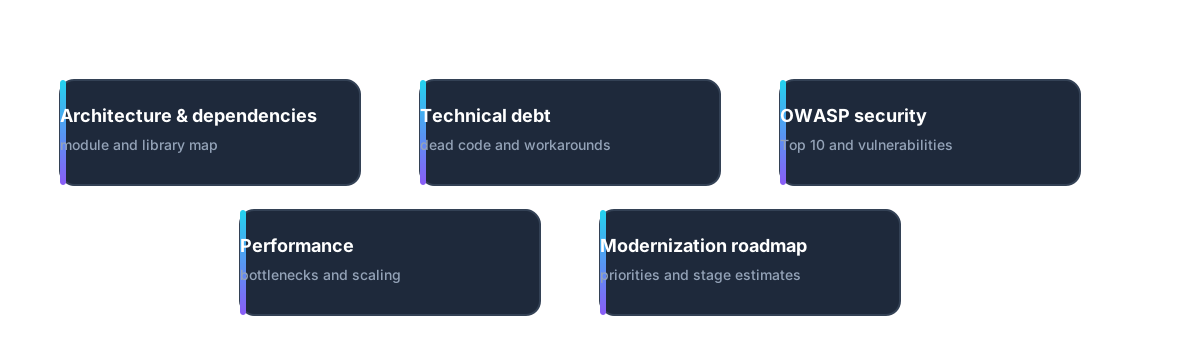
I run a comprehensive audit: architecture and dependency analysis, dead code and technical debt identification, security review (OWASP Top 10), performance and scalability analysis, and recommendations with a modernization roadmap. The audit answers three questions: what exactly blocks the system’s growth, which order of fixes minimizes business risk, and what each stage will cost. The result is a report with priorities, estimates and a module plan — you decide what to modernize first. An audit at 2,000 PLN net gives you an exact quote for the whole programme; the full scope is described in the article “Legacy code audit step by step”.
Step-by-step modernization — the strangler fig pattern
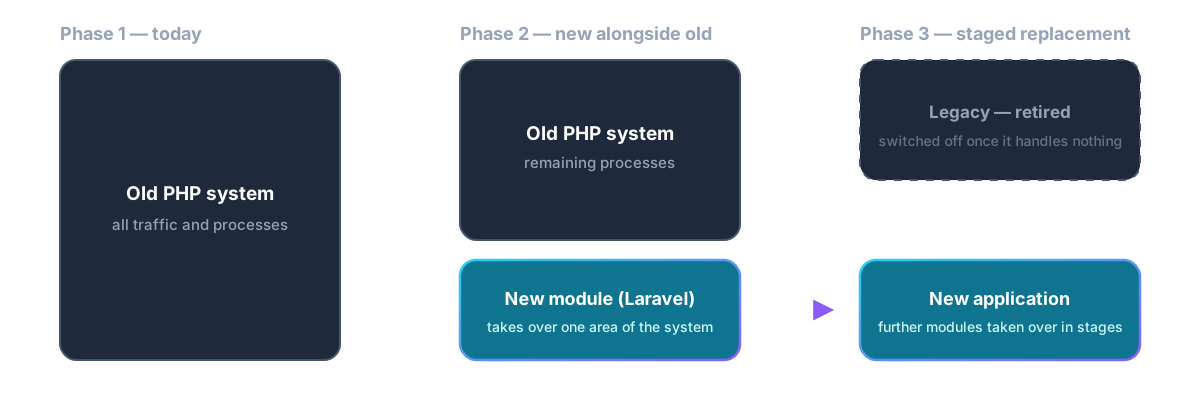
I do not rewrite everything from scratch — that is too risky and too expensive. I use the proven strangler fig pattern: new modules (e.g. in Laravel) run alongside the old application and take over successive areas of the system, and the old code is retired only once the new path is tested in production. I pick one module, protect it with characterization tests, refactor it, deploy to staging, monitor and promote to production. Only then do I move to the next module. The small-steps strategy minimizes risk, delivers value quickly and never leaves the company without a working system. How this looks in practice is described in the article about the strangler fig pattern.
Refactoring and characterization tests
Refactoring improves the structure of the code without changing its behaviour — and it is only safe when we first describe the system’s current behaviour with characterization tests. These tests are written from observed behaviour: they pin down what the system does today (including business-relevant bugs) so that refactoring changes nothing unexpectedly. In practice: I cover critical paths with tests (orders, billing, integrations), refactor module by module, remove dead code and dependencies, and deploy every change through staging with a rollback plan. Refactoring instead of a rewrite is usually 3–5× cheaper and far less risky. When to refactor and when to rewrite from scratch is covered in the article about legacy code refactoring.
PHP 5.6/7.x → 8.x migration with Rector
PHP 7.x no longer receives security patches — every version below 8.1 is out of support, and PHP 8.1 loses it on 31 Dec 2026. A migration is not just a version bump: new PHP versions break some old constructs, so it needs to be done layer by layer: compatibility audit (PHPCompatibility, PHPStan), regression tests, automated refactoring with Rector (the tool automates PHP changes — it rewrites deprecated constructs into their modern equivalents), staging deployment and post-switch monitoring. A jump from PHP 5.6 requires an intermediate version. Upgrading from 8.2/8.3 to 8.4 usually takes 1–3 days of work; migrating from 7.4 to 8.x — 1–2 weeks for a small project. The full process, with a support-date table, is described in the PHP migration guide.
Technical debt — how we measure and reduce it
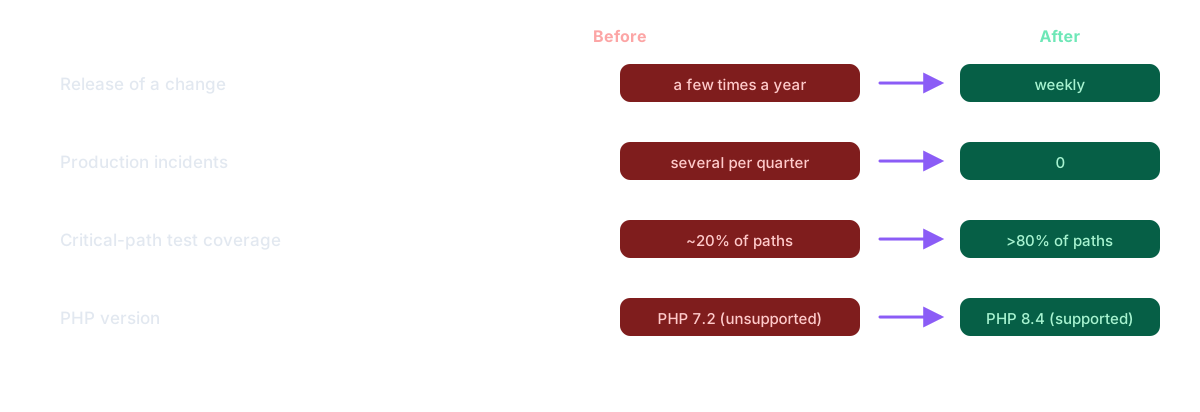
Technical debt is the cost a company pays for every change to the system: longer releases, more bugs, slower development and growing maintenance costs. Instead of describing it in generalities, I measure it with concrete indicators: test coverage of critical paths, number of known vulnerabilities in dependencies, time to release a change, number of production incidents per quarter, and time for a new person to make their first commit. These numbers show before and after modernization — so the programme has a measurable effect, not just “tidier code”. Example metrics from a real project are shown in the graphic below.
DevOps and infrastructure
I implement CI/CD, automate deployments, set up monitoring (servers, databases, applications), backup and disaster recovery, and optimize servers and databases — including moving applications to cloud hosting with predictable costs. Releases stop being a manual ritual: every change goes through automated tests, static analysis (PHPStan/Larastan) and a one-command deployment with instant rollback. Monitoring with alerts (Sentry, Horizon, New Relic) catches problems before users notice them.
AI-assisted modernization — what it really speeds up
AI assistants shorten the most expensive stage of modernization: understanding what the old code actually does. In practice I use AI in three places: mapping dependencies in a module I am seeing for the first time; generating drafts of characterization tests, which I then verify by running them; and mass refactorings, where Rector performs the change and AI helps prepare the rules. The boundary is fixed: architecture decisions, risk assessment and code review stay human — no unreviewed code ever reaches production, and your code and data are never used to train public models. The result: a shorter time to understand the codebase and faster test coverage — without giving up control of the system.
Legacy WordPress, PrestaShop or a custom CMS
Legacy is not only custom code. Outdated WordPress, WooCommerce and PrestaShop sites have exactly the same problems: PHP past end of life, unmaintained plugins and themes, growing security risk, slow performance and blocked development. I modernize them with the same methodology: inventory and backups, staged updates (never live on production), malware removal after an infection, PHP migration and performance optimization. WordPress sites and PrestaShop stores then continue under technical care — with updates, backups, monitoring and an SLA.
Which systems I modernize
Typically: e-commerce applications and stores (PrestaShop, WooCommerce) integrated with ERP, marketplaces and carriers; B2B systems and internal company tools (orders, inventory, billing, a sales rep panel); SaaS applications and client portals; systems taken over from another vendor — with no documentation and nobody who knows them. The challenges are always similar: no tests, manual releases, technical debt blocking growth and a PHP version past end of support. The first step is always the same: an audit, a risk report and a modernization roadmap with cost estimates.
Packages and rates
Four engagement models — from a one-off audit to an ongoing retainer. Every stage has a fixed price and a concrete outcome; you pay for the modernization programme step by step, with no commitment to the whole.
Technical code audit
2,000 PLN net
3–5 days
Report: architecture, technical debt, OWASP security, performance and a modernization roadmap with stage estimates. The starting point of every modernization programme.
Staged modernization
2,000–25,000 PLN net
billed per stage/module
Module-by-module refactoring with characterization tests: one release = one module. Fixed price per stage, invoiced on acceptance.
PHP 5.6/7.x → 8.x migration
3,000–40,000 PLN net
3 days – 8 weeks
Compatibility audit, Rector, regression tests, deployment and monitoring. Small project from 3,000 PLN, medium system with integrations 10,000–40,000 PLN.
Care & development retainer
from 2,000 PLN net/month
monthly retainer
After modernization: further modules, dependency updates, monitoring, SLA and an hours package for development. The system keeps getting cleaner without a new project.
How we work, step by step
Modernization in 7 steps — from audit to the next modules. Every stage ends with a working release and a measurable effect, not a report for the drawer.

Audit and inventory
Analysis of code, architecture, dependencies, security and performance. A report with technical debt, risks and a modernization roadmap with cost estimates.
Modernization plan and priorities
Together we set the module order — first what most blocks growth and generates risk. Every stage has a scope, price and acceptance criteria.
Characterization tests
I pin down the system’s current behaviour with tests on critical paths (orders, billing, integrations) — this is the safety net for refactoring.
Module refactoring
Rebuilding the module (often in Laravel alongside the old app — strangler fig), removing dead code, updating dependencies, PHPStan static analysis.
Staging and regression tests
Deployment to a test environment with a data copy, regression and performance tests, code review. The module moves on only after your acceptance.
Production release
Module-by-module release, in a deployment window, with a rollback plan and post-change monitoring. No downtime and no big bang.
Monitoring and the next module
After a stable period we move to the next module. The programme advances in stages while you always have a working system.
Contract, security and code ownership
No production downtime
I work module by module through staging, with a rollback plan and monitoring. The system runs throughout — releases need no service window and no night work.
Code and knowledge stay with you
The code goes into your repository from the first commit, and rights transfer to you once the invoice is paid. Every stage ends with documentation and knowledge transfer — I do not lock clients in.
Measurable results, not “tidier code”
The programme has metrics: release time, incident count, test coverage, supported PHP version. The effect is visible in numbers, not in claims.
Payment per stage
You do not pay for the whole programme upfront. We settle each module after acceptance, and after every stage you can decide to continue — or stop with no strings attached.
Comparison
Refactoring, strangler fig, a rewrite or freezing the system? A comparison of four modernization strategies — cost, risk and control.
| Model | Best for | Cost | Risk | Control |
|---|---|---|---|---|
| Module-by-module refactoring | Systems that work and must keep working | 2,000–25,000 PLN in stages | Low: tests, staging, rollback | Full — you decide after every stage |
| Strangler fig (new alongside old) | Large systems with critical processes | like refactoring + new modules | Low: old paths work until switchover | Full — switchover module by module |
| Rewrite from scratch | Systems with no tests and no way to maintain them | 3–5× more than refactoring | High: a multi-month project with no value along the way | Limited until the project ends |
| Freezing the system (doing nothing) | None — this is a “wait it out” strategy | hidden: growing change costs and outage risk | Grows every month (EOL, vulnerabilities) | Apparent — the problem compounds on its own |
Technology stack
Legal basis and standards
Related services
- Laravel development Continuing application development after clean-up.
- Hire a Laravel developer Support hourly, fixed price or on retainer.
- WordPress maintenance & care Care and security for WordPress sites.
- Case study: PHP application modernization — 5.6 to 8.4 Zero critical incidents in 12 months, deployments from 2 weeks to 2 days — with before/after metrics.
- Topic hub: legacy modernization — guides Audit, refactoring, strangler fig, characterization tests, technical debt and PHP migration.
- PHP Migration & Upgrade Guide — 5.6/7.x to 8.x Compatibility audit, Rector, tests and deployment — with support dates and costs.
- PHP 8.2 end of life — 31 December 2026 The deadline, three scenarios and an action plan for the rest of the year.
Worth reading
- Legacy code modernization, step by step Small steps, regression tests and zero-downtime releases.
- Legacy code refactoring guide Characterization tests, module-by-module refactoring and when NOT to rewrite.
- Legacy code audit — scope, cost and modernization plan What the audit covers, what it costs and how to read the roadmap.
- Technical debt management Technical debt metrics and a staged reduction plan.
- Strangler fig pattern — modernization without a rewrite How the strangler fig works and when to use it instead of a big-bang rewrite.
- Characterization tests for legacy code How to pin down old code with tests before refactoring.
- PHP migration and upgrade guide — 5.6/7.x to 8.x Compatibility audit, Rector, tests and deployment — with support dates and costs.
- PHP migration checklist — 30 points Five phases from inventory to monitoring, with acceptance criteria.
FAQ
What is legacy code?
Legacy code is working code that cannot be changed safely: it usually lacks tests, its dependencies are outdated, and knowledge of the system lives only in the author’s head. Code does not become legacy because it is old — it becomes legacy when it blocks growth: every change risks a regression, and the PHP version and framework are long past end of life. You can read more about identifying the problem in the article “What is legacy code?”.
When should I refactor and when should I rewrite the system from scratch?
In most cases refactoring — improving the structure of existing code while preserving its behaviour — is cheaper (3–5×) and safer. A rewrite only makes sense when the system can no longer be maintained: no tests or documentation, technology without support or hiring prospects, and a business that accepts a multi-month project with no value along the way. In practice, the best results come from the middle path: strangler fig — new modules alongside the old system, taking over functionality in stages.
What does a code audit include?
An analysis of architecture and dependencies, identification of dead code and technical debt, a security review (OWASP Top 10), performance and scalability analysis, and a modernization roadmap with stage estimates. An audit at 2,000 PLN net (3–5 days) delivers a report with priorities and an exact quote for the modernization programme.
Does modernization require stopping the system?
No. I work module by module: characterization tests, refactoring, staging, release and monitoring. The system runs throughout, every change is verified with regression tests, and releases have a rollback plan. I do not do big-bang switchovers with no way back.
How much does a PHP upgrade cost?
A small project (up to ~20k lines): 3,000–10,000 PLN net, 3–10 days of work. A medium system with a framework and integrations: 10,000–40,000 PLN net, 2–8 weeks. Large legacy systems billed in stages: from 40,000 PLN. The starting point is a technical audit at 2,000 PLN net, which produces an exact quote for your project.
How long does a PHP upgrade take?
Upgrading from 8.2/8.3 to 8.4 usually takes 1–3 days of work. Migrating from 7.4 to 8.x: 1–2 weeks for a small project, 2–8 weeks for a medium system with a framework and integrations. A jump from PHP 5.6 requires an intermediate version and takes longer — typically 2–4 weeks for a small project.
Why is PHP 7.x a risk?
PHP 7.x no longer receives security patches — every version below 8.1 is out of support, and PHP 8.1 loses it on 31 Dec 2026. Code on an unsupported PHP version means growing vulnerability risk (no public fixes) and problems with dependencies that require a newer PHP. An upgraded PHP also delivers real performance gains: PHP 8.x is several times faster than 5.6 on the same code.
How much does application maintenance cost after modernization?
A technical audit is 2,000 PLN net one-off. A development retainer with an SLA and an hours package — from 2,000 PLN net per month (further modules, dependency updates, monitoring). Ongoing care: from 300 PLN net per month for a site and 400 PLN for a store (updates, backups, monitoring, minor fixes). A large modernization programme billed in stages: 2,000–25,000 PLN.
Can refactoring break a working system?
It can — if it is done without tests and without module-by-module releases. With characterization tests (pinning down current behaviour), a staging environment and post-release monitoring, the risk is limited to one module rather than the whole system. That is exactly why I start with tests, not with refactoring.
Where should I start with modernization?
With a technical audit. Without a report on risks and a roadmap, any modernization is guesswork: you might rewrite a module that works fine and skip the one that actually blocks growth. An audit at 2,000 PLN net (3–5 days) gives you priorities, stage estimates and an action plan — only then do you decide on the scope of work.
Do I get support after modernization is finished?
Yes. After every stage you receive documentation and knowledge transfer, and after the whole programme — monitoring and an optional development retainer with an SLA (from 2,000 PLN net per month). I do not lock clients in: the code and knowledge stay with you, so you can keep developing the system yourself or with another team.
What are legacy PHP modernization services?
Legacy PHP modernization services cover the whole path of an old system to supported technology: a code audit and dependency map, characterization tests on critical paths, module-by-module refactoring (often with the strangler fig pattern), a PHP 8.x migration with Rector, CI/CD and monitoring. The goal is a maintainable codebase on a supported PHP version — without a rewrite and without stopping production.
What tool accelerates legacy modernization?
Rector accelerates it the most — it automatically rewrites PHP constructs to newer versions (80–90% of the mechanical work). The compatibility audit is supported by PHPCompatibility and PHPStan, the safety net comes from PHPUnit/Pest, and AI assistants shorten the time to understand old code and draft characterization tests. Architecture decisions and risk assessment always stay human.
Is PHP still used in 2026?
Yes — PHP powers most of the web (WordPress, WooCommerce, PrestaShop, Laravel, Symfony), and the current branch is PHP 8.5. The problem is not the language but old versions: PHP 5.6, 7.x and 8.1 are past end of life, and PHP 8.2 loses support on 31 December 2026. Modernization does not mean abandoning PHP — it means upgrading to a supported version.
Do you have an example of a modernization project?
Yes — the case study of a PHP application modernized from 5.6 to 8.4: audit, PHPUnit regression tests, Rector refactoring, GitHub Actions CI/CD and monitoring. The result: zero critical incidents for 12 months, deployments cut from 2 weeks to 2 days and maintenance costs down 60%. The full before/after metrics are described in the case study.
Which PHP versions are still supported?
As of 2026: PHP 8.4 and 8.5 are in full support, PHP 8.3 receives security fixes only (until 31 Dec 2027), PHP 8.2 reaches end of life on 31 December 2026, and PHP 8.1 and older are already end-of-life. A system on PHP 8.2 needs a migration plan this year — after 31 December new interpreter vulnerabilities will stay unpatched.
Why do companies still use legacy systems?
Because they work and run critical processes: orders, inventory, billing. A rewrite is a multi-month project with no value along the way and high regression risk — so companies postpone the decision until the cost of doing nothing exceeds the cost of modernization (growing maintenance costs, no specialists, blocked growth). Staged modernization resolves that deadlock: value is delivered after every module.
Can you modernize a system without documentation, built by another vendor?
Yes — that is a typical starting point. Characterization tests pin down the system’s observed behaviour, so documentation is not a prerequisite: first the audit and dependency map, then tests on critical paths and module-by-module refactoring. Every stage ends with knowledge transfer and documentation, and the code goes into your repository from the first commit.
Krzysztof Słonina
Senior full-stack developer, owner of Inoventis Solutions
16 years in PHP/Laravel, e-commerce integrations and legacy modernization. Has led staged modernization programmes for production systems — from audit to PHP 8 migration. Author of technical posts on the informatix blog.
Results from real projects
PHP application modernization
Zero critical incidents for 12 months
Read the case studyCRM application and client portal
50% less time on administrative work
Read the case studyIndicative ranges for this service: see pricing
Web app requirements checklist
12 control questions to answer before talking to a vendor — faster estimates, fewer hidden costs.
Struggling with legacy code?
Order a code audit — you will receive a report with risks, a modernization roadmap and stage estimates within 24 h of the brief. No commitment.
Order a code audit