Service
Laravel Development Services
Web applications, REST APIs, SaaS platforms and admin panels in Laravel 12 and PHP 8.4 — from scope analysis to post-launch support.
Laravel is an open-source PHP framework built on the MVC (Model-View-Controller) pattern, created by Taylor Otwell in 2011 and today the most popular PHP framework in the world. I build web applications with it: SaaS platforms, REST APIs, admin panels and industry systems (CRM, ERP, e-commerce, e-learning). I design the domain architecture, write the tests, ship through CI/CD and stay with you after launch: maintenance, growth and SLA. I work with companies and agencies across Poland, the EU and the US — remotely, with weekly demos and reporting.
Last updated: 27.10.2026
Budget range
90 – 160 PLN net / hour (≈ €21–37)
Final fixed price after a free scope analysis — no hidden costs.
What is Laravel? A PHP framework in practice
Laravel is a free, open-source PHP framework for building web applications, released by Taylor Otwell in 2011 and developed by the community and Laravel LLC. It implements the MVC (Model-View-Controller) architectural pattern and ships ready-made components you would otherwise build from scratch in plain PHP: routing, the Eloquent ORM, Blade templates, authentication, queues, validation and database migrations. The ecosystem covers dependency management (Composer and Packagist), production tooling (Laravel Forge, Laravel Vapor), admin panels (Filament), queues (Laravel Horizon) and debugging (Laravel Telescope). For businesses this means faster delivery, predictable maintenance costs and easier hiring — Laravel developers are the largest group of specialists in the PHP ecosystem.
Why companies and startups choose Laravel
A fast start (an MVP in weeks, not months), a mature package ecosystem, built-in security (CSRF, XSS and SQL injection protection, password hashing) and predictable development costs. Laravel applications scale from a first release to thousands of users thanks to queues, caching and PostgreSQL — and the code is easier to read than projects written from scratch, which lowers the cost of a project takeover by another team.
Laravel vs Symfony, Node.js and no-code
I choose Symfony for complex enterprise systems with custom bundles, and Node.js when the team is fully JavaScript. No-code and WordPress win for simple sites and processes — Laravel starts to win when custom business logic, integrations (ERP, CRM, payments), subscription billing, role systems or a customer portal enter the picture. If you are unsure which stack fits, a free technical consultation will settle it based on your processes, not on trends.
What I build with Laravel
The scope covers the full application lifecycle: workshop and scope analysis, architecture, development, testing, deployment, documentation and post-launch care. Most often I build:
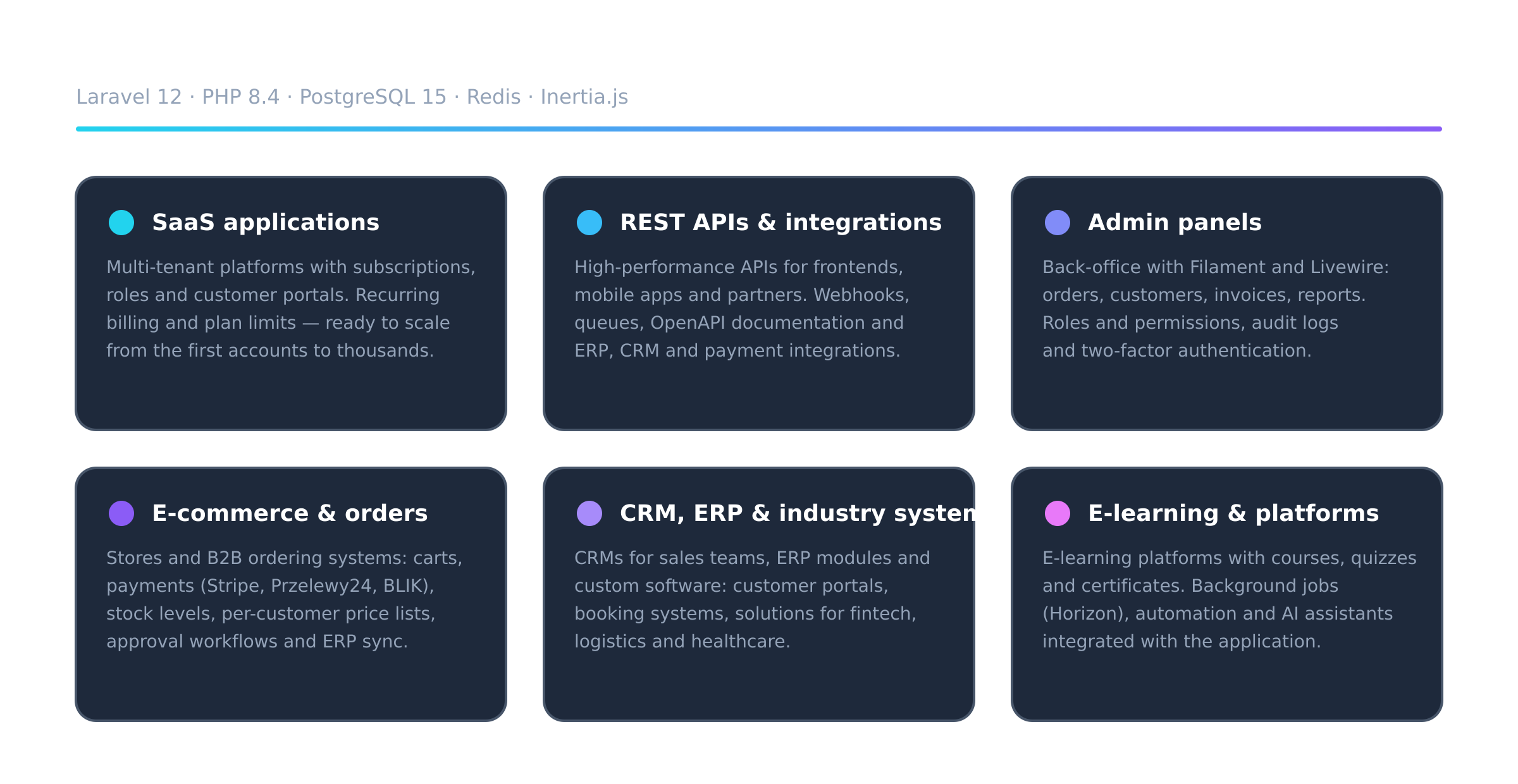
SaaS platforms and multi-tenant applications
Multi-tenant applications with subscriptions, roles and customer portals. Recurring billing, plan limits and self-service onboarding — architecture ready to scale from the first customers to thousands of accounts.
REST APIs and integrations
High-performance REST APIs (and GraphQL where it earns its place) for frontends, mobile apps and partners. Webhooks, queues, OpenAPI documentation and integrations with ERP, CRM, marketplaces and payment providers.
Admin panels and back-office
Panels built with Filament and Livewire: orders, customers, invoices, tickets, reports and exports. Field-level roles and permissions, audit logs and two-factor authentication as standard.
E-commerce and order systems
Laravel-based stores and B2B ordering systems: carts, payments, stock levels, per-customer price lists, approval workflows and ERP synchronisation.
CRM, ERP and industry systems
CRM systems for sales teams, ERP modules and custom software: customer portals, booking systems, e-learning platforms with courses, quizzes and certificates.
Automation, queues and AI
Background jobs and schedulers (Laravel Horizon), automated invoicing and reporting, and AI assistants integrated with your application — without sending customer data to public models without a legal basis.
Industries and project types
I work with companies in fintech and insurance, e-commerce and marketplaces, logistics and TSL, healthcare, education (e-learning) and with SaaS businesses and startups. In industry projects, code is only part of the job: I understand the business processes, provide handover documentation and account for compliance requirements — GDPR, auditability of changes and access control.
Case studies and own products — evidence, not claims
Beyond client projects I build and run my own SaaS products on Laravel, where architecture is battle-tested: OneCRMApp (a CRM for insurance agents with a client portal and KSeF integrations), ShipNOrder (shipping automation and e-commerce integrations: marketplaces, carriers, ERP) and FamilyTimelineApp (a web application with React and Inertia.js). Client work has produced case studies with numbers: PHP application modernization (zero critical incidents for 12 months), CRM application and client portal (50% less time on administrative work) and omnichannel sales integration (order handling time cut by 40%). These are custom systems running in production — you can review them before making a decision.
Quality standards, testing and security
Every project starts with architecture — I define domains, entities, services and repositories (domain-driven design). I write automated tests (PHPUnit, Pest) covering critical business paths, run CI/CD with GitHub Actions, static analysis with PHPStan and code review against SOLID. Security is verified against the OWASP Top 10: input validation, protection from SQL injection and XSS, rate limiting, 2FA and audit logging. Laravel web applications are also SEO-friendly: clean URL structure, fast server-side rendering and full control over metadata make search optimisation easier.
Technology stack
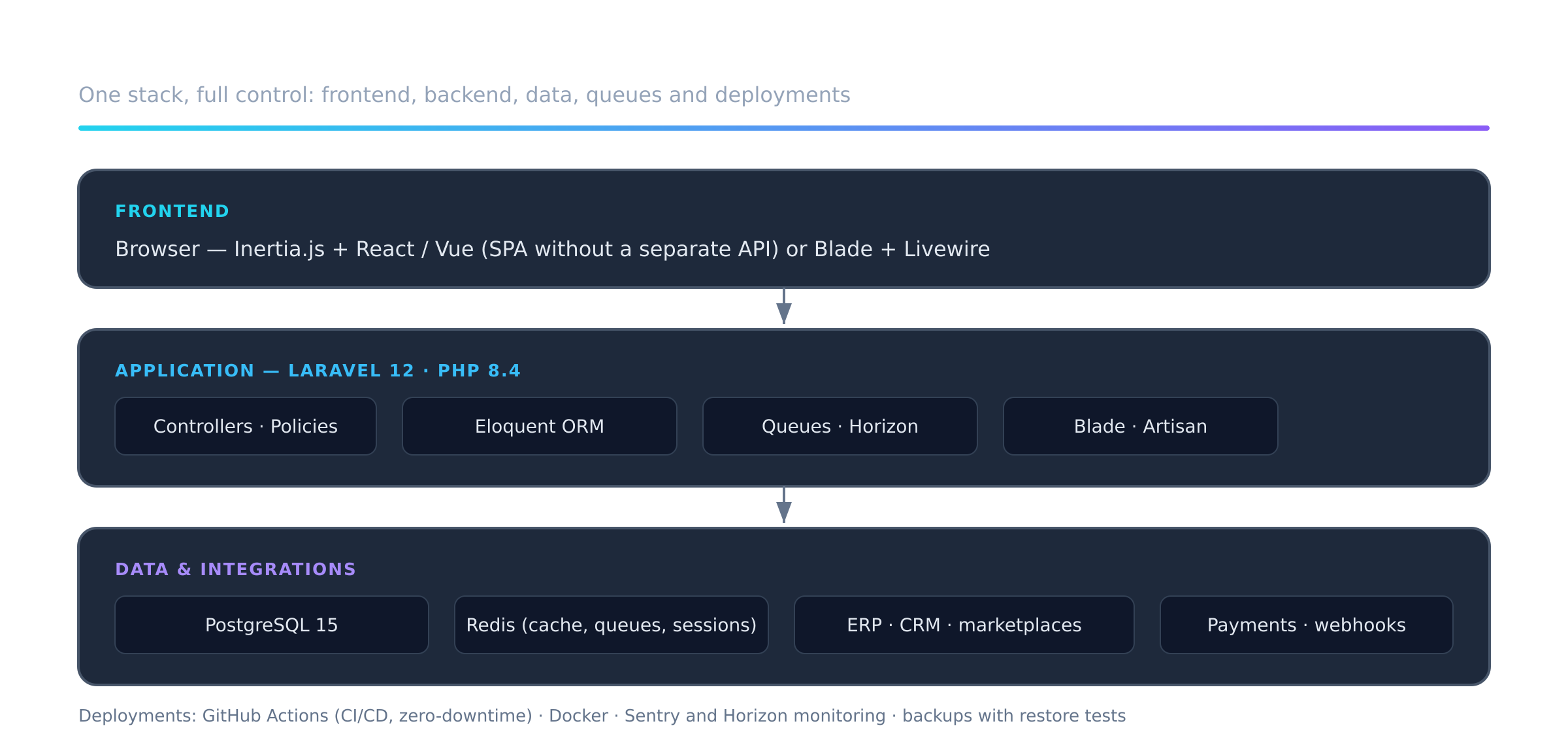
Backend: Laravel 12 and PHP 8.4 with Eloquent ORM, Blade and the Artisan CLI. Frontend: Inertia.js with React or Vue (a SPA without a separate API) or Filament and Livewire for admin panels. Data: PostgreSQL 15 and Redis (cache, queues, sessions). Infrastructure and hosting: deployments on VPS and in the cloud, Docker, GitHub Actions, plus Laravel Forge and Laravel Vapor for environment management — Horizon for queues, Telescope for debugging and Sentry for production error monitoring. Dependencies are managed with Composer and Packagist, API authentication with Laravel Sanctum, and the stack is rounded out with Spatie packages and in-house libraries.
Taking over and modernizing an existing project
I take over projects from other developers and agencies: I start with a code audit, set up characterization tests and prepare a modernization plan, then develop the application module by module — without interrupting the running system. I migrate legacy PHP applications (5.6/7.x) to modern Laravel with Rector and regression test coverage. When the application is a monolith with growing technical debt, I apply the strangler fig pattern instead of a risky rewrite. I also provide Laravel consulting and architecture audits for teams developing an application in-house — with a report, priorities and a remediation plan.
Maintenance, SLA and post-launch growth
After launch I stay: a development retainer covers new features, dependency and PHP upgrades, monitoring (Sentry, Horizon), backups and a response time written into the SLA. I do not disappear after handover — documentation, knowledge transfer and technical care are part of the engagement, not an add-on.
White-label support for agencies
Agencies and software houses can hand me the backend, integrations and maintenance of Laravel applications under their own brand — I work as a dedicated backend team for your agency: NDA, reports ready to forward to the end client, communication in your name and 20/40/80 h monthly hour packages. It is the fastest way to expand your team’s capacity without hiring.
Packages and rates
Four engagement models — from hourly to white-label for agencies. Costs are explicit in every model; you can switch rates as the project evolves.
Hourly (T&M)
90–160 PLN/h net (≈ €21–37/h)
min. 10 h
Billed for actual work — for evolving scopes, urgent fixes and developing existing applications.
- Monthly time report
- Full control over priorities
- Start within 1–2 weeks
Fixed price
from ~30,000 PLN net (≈ €7,000, MVP)
smaller modules from 15,000 PLN
A fixed price for a defined scope: MVP, module, integration, panel. Milestones and acceptance criteria written into the contract.
- Quote after a free scope analysis
- Fixed price and deadline
- Staged acceptance
Development retainer
from ~2,000 PLN/month net (≈ €470)
monthly hour packages
A monthly package of hours for development and maintenance — the application keeps evolving without renegotiating every change.
- Priorities and SLA
- Updates and monitoring
- Monthly report
White label (agencies)
from ~3,600 PLN/month net (≈ €840, 40 h)
20/40/80 h packages
Backend, integrations and maintenance under the agency’s brand — with an NDA and reports for the end client.
- NDA and confidentiality
- Communication in your name
- Package scaling
How we work, step by step
A predictable process from the first call to post-launch care — with weekly demos and staged module acceptance.

Free scope analysis
A workshop: business goals, features, integrations and constraints. You get the scope, risks and a budget range — no strings attached.
Fixed quote and module plan
A fixed price or rate, a schedule and a breakdown into modules with acceptance criteria. Contract, NDA and transfer of code rights.
Architecture and foundation
Domain model, PostgreSQL schema, staging and production environments, CI/CD and monitoring from the first commit.
Development with weekly demos
I ship in modules: every week you see a working version on staging; every change passes tests and code review.
Production deployment
Zero-downtime deploy with GitHub Actions, database migrations, smoke tests and a rollback plan. Monitoring alerts before users notice.
Care, SLA and growth
After launch: maintenance, upgrades, new features and an SLA response time. Documentation and knowledge transfer included.
Contract, security and code ownership
Contract, NDA and code ownership
Copyright to the code transfers to you; I will sign an NDA before the first technical call. B2B engagement.
Security and GDPR
Data in the EU, data minimisation, processing agreements and secure practices: OWASP Top 10, 2FA, dependency audits.
No vendor lock-in
The repository, documentation and deployment instructions are yours — another team can take the project over at any time.
One person, full accountability
You work directly with the senior developer who designs, codes and deploys — no middlemen, no agency overhead.
Comparison
A comparison of engagement models — pick the one that fits your project stage and risk tolerance.
| Model | Best for | Cost | Risk | Control |
|---|---|---|---|---|
| Hourly (T&M) | Evolving scopes, urgent work | 90–160 PLN/h | Low — you pay for work done | Full control over priorities |
| Fixed price | Known scope: MVP, module, integration | from ~30,000 PLN (MVP) | Low for you — carried by the vendor | Milestones and acceptance |
| Retainer | Continuous growth after launch | from ~2,000 PLN/month | Low — flexible priorities | Monthly budget set upfront |
| White label (agencies) | Agencies and software houses | from ~3,600 PLN/month (40 h) | Low — NDA and confidentiality | Your brand, my delivery |
Technology stack
Related services
- Legacy PHP modernization Audit, refactoring and upgrades of existing systems.
- Hire a Laravel developer Rates, engagement models and scope.
- Laravel admin panels (Filament) Back-office, CRM and partner panels.
- Laravel project takeover Audit, 30/60/90 plan and a safe handover.
- Laravel support for agencies (white label) 20/40/80 h packages, NDA and client-ready reports.
- Laravel Development Cost in 2026 Project budgets from MVP to SaaS and hidden costs.
- Laravel E-commerce Development — when custom wins When custom beats Shopify and WooCommerce.
- Laravel for startups and SaaS — MVP to scale Architecture, costs and first-year pitfalls.
- Automation & AI AI assistants and process automation for your company.
Worth reading
- Laravel Development Cost in 2026 Project budgets from MVP to SaaS, cost drivers and hidden costs.
- Laravel E-commerce Development When custom beats Shopify and WooCommerce.
- Laravel for Startups and SaaS From MVP to scale — architecture, costs and pitfalls.
- Laravel Developer Salary in Poland [2026] Salary ranges, required skills and hiring costs.
- Laravel Application Security — OWASP Top 10 SQL injection, XSS and application hardening.
- Laravel Performance Optimization Guide N+1 fixes, caching, queues and indexing.
- Laravel Project Takeover Checklist What to check before taking over someone else’s code.
- White-Label Laravel Development for Agencies Engagement model, NDA and hour packages.
FAQ
How much does Laravel development cost?
My rate is 90–160 PLN net per hour (≈ €21–37). An MVP typically starts at around 30,000 PLN net (≈ €7,000), smaller modules and integrations from 15,000 PLN, and a maintenance retainer from 2,000 PLN per month (≈ €470). You get a fixed quote after a free scope analysis — no hidden costs.
Is Laravel still a good choice in 2026?
Yes — Laravel remains the most popular PHP framework: fast start, a mature ecosystem (Horizon, Filament, Forge, Vapor) and a large talent pool, which lowers development and maintenance costs. For businesses the key benefit is predictability: when processes become non-standard, Laravel scales cheaper than no-code tools that start to constrain you.
Do large companies use Laravel?
Laravel powers applications from startups to large organisations — thousands of production systems run on it in SaaS, e-commerce and fintech. Scaling is handled by queues (Horizon), Redis, PostgreSQL and horizontal application scaling. Instead of relying on rumours, I will show you the architecture and metrics of similar systems I have built.
Will you take over my existing project?
Yes. I start with a code audit and test setup, prepare a modernization plan, then develop the application module by module — without interrupting the running system. Taking over Laravel and legacy PHP projects is one of my core services.
How long does it take to build a Laravel application?
An MVP usually takes 6–10 weeks; a mid-sized application with a panel and integrations takes 3–6 months. After the scope analysis you get a schedule broken down by module and weekly demos — you see progress as it happens, not at the handover.
Can I start with a small MVP?
Yes — most of my projects started as MVPs. We pick the smallest feature set that delivers value (e.g. one process and one integration), ship it in a few weeks and grow it based on feedback. The architecture is built to scale from day one.
Do you work white-label for agencies?
Yes. I run the backend, integrations and maintenance of applications under the agency’s brand: NDA, communication in your name, reports for the end client and 20/40/80 h monthly hour packages.
Will the application be GDPR-compliant?
Yes. I design with GDPR in mind: data in the EU, data minimisation, encryption, access control, audit logging and processing agreements. For sensitive data I choose solutions that meet your industry’s requirements.
When should I choose Laravel over WordPress or no-code?
WordPress wins when you need a fast start and a simple content site; no-code works for simple processes without unusual logic. Laravel starts to win when custom business logic, integrations (ERP, CRM, payments), roles, subscription billing or a customer portal enter the picture — that is when no-code becomes an expensive constraint.
Will I get the code and documentation?
Yes — the repository, technical documentation, deployment instructions and access credentials are transferred to you, with copyright assigned by contract. Another team can take the project over at any time, without asking me for permission.
What is Laravel?
Laravel is a free, open-source PHP framework for building web applications, based on the MVC architectural pattern. It provides ready-made components: routing, the Eloquent ORM, Blade templates, authentication, queues and database migrations — which makes applications faster to build and easier to maintain than plain PHP projects.
Who created Laravel and when?
Laravel was created by Taylor Otwell in 2011 and is still developed by him together with the community and Laravel LLC. The framework gets regular yearly releases (currently Laravel 12), and the ecosystem includes Forge, Vapor, Filament, Horizon and thousands of packages available through Composer and Packagist.
Is Laravel free?
Yes — Laravel is released under the MIT licence and is free for commercial use as well. Only optional official tools are paid (e.g. Laravel Nova or Laravel Cloud/Vapor hosting), plus third-party service subscriptions — the framework itself and its core ecosystem carry no licence fees.
Laravel or Symfony — which PHP framework should I choose?
I choose Laravel for most business applications: a faster start, simpler syntax and a richer package ecosystem lower the cost of building and maintaining them. Symfony can be better for large enterprise systems with custom bundles and a Symfony-savvy team. Both build on PHP and proven components — base the decision on your processes and team skills, not on trends.
Is a Laravel application secure?
Laravel ships security mechanisms by default: CSRF and XSS protection, parameterised queries (SQL injection protection), password hashing (bcrypt/Argon2) and input validation. On projects I additionally implement 2FA, rate limiting, audit logging and OWASP Top 10 verification — security depends on implementation practices, not on the framework alone.
Is Laravel good for SEO?
Yes — Laravel renders HTML server-side, which Google indexes without issues, and full control over URLs, metadata, canonicals and structured data makes optimisation easier. For stores and portals that means fast loading (caching, queues) and clean content structure without the constraints of no-code platforms.
Laravel or Node.js for an application backend?
Laravel wins when fast delivery of business features matters: ready-made authentication, ORM, queues, an admin panel and a huge pool of PHP developers. Node.js makes sense for fully JavaScript teams, real-time applications (chat, live notifications) or sharing code with the frontend. Both scale well — the difference is team cost and time to market.
Where should I host a Laravel application and what does it cost?
Typical options are a VPS (from roughly 50–150 PLN/month for an application with a database and queues), managed infrastructure with Laravel Forge, or serverless Laravel Vapor for variable traffic. Larger systems with PostgreSQL, Redis and queues run on cloud clusters (AWS, Hetzner, OVH). I match hosting to scale and budget — deployment, monitoring (Sentry) and backups are part of the engagement.
Krzysztof Słonina
Senior full-stack developer, owner of Inoventis Solutions
16 years in PHP and Laravel: SaaS applications, CRM and ERP systems, e-commerce integrations and the takeover and modernization of existing projects. Builds own products (OneCRMApp, ShipNOrder) and supports agencies as a white-label backend partner.
Results from real projects
PHP application modernization
Zero critical incidents for 12 months
Read the case studyCRM application and client portal
50% less time on administrative work
Read the case studyIndicative ranges for this service: see pricing
Web app requirements checklist
12 control questions to answer before talking to a vendor — faster estimates, fewer hidden costs.
Have a Laravel project in mind?
Tell me about your idea — I will prepare a free scope analysis and a budget range within 48 h.
Book a free consultation