
Website Development Process — 7 Stages from Brief to Launch
The website development process has 7 stages: brief and goals, architecture and quote, UI design, content, development, testing and handover, and launch with care. The whole project takes from 2 weeks (business card) to 4 months (a portal with logins). The biggest risk is not code — it is content and decisions on the client side, which is why the process is designed so that no decision blocks the work for more than a few days.
This article breaks each stage down: what happens, how long it takes, what you need to deliver and what you get at the end. You will also find a timeline table for three project types and the things that most often delay a build.
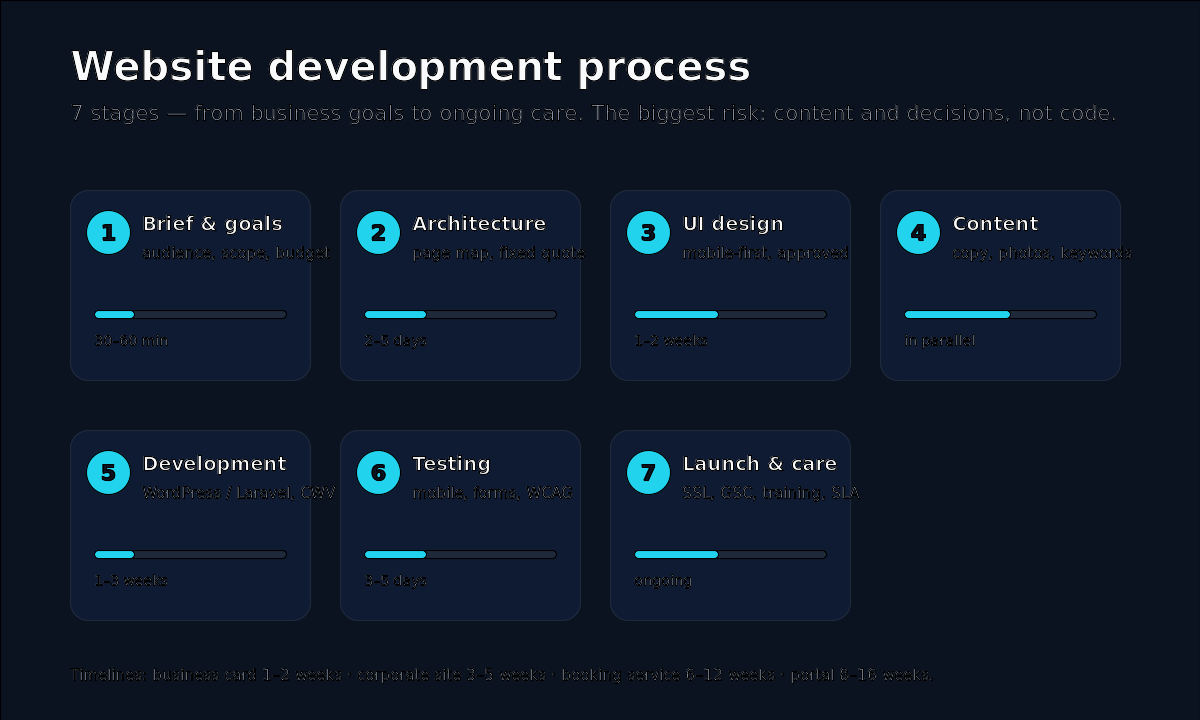
Stage 1: Brief and goals — 30–60 minutes
Every project starts with a conversation, not a quote. I collect business goals (leads, sales, recruitment, branding), the target audience, scope, budget and deadline. We agree what the site must achieve and what is critical at launch.
A good brief answers three questions: who will land on the site and what decision they must make; what the user should do (call, submit a form, book, buy); and how we will measure success. If a developer starts with “which template?” instead of “what must the site achieve?”, you are buying a product, not a tool.
Stage 2: Architecture and quote — 2–5 days
The brief becomes a page map, content structure and the user path to contact. At the same time we make the technology decision: WordPress where fast launch and self-service editing matter; Laravel where you need custom logic, integrations and performance under load.
The output is a document with the information architecture, a feature list and a fixed quote — item by item. A fixed price protects both sides: you know what you pay, the developer knows what they deliver. The quote should also state exclusions explicitly, so nothing surfaces later as a surprise.
Stage 3: UI design — 1–2 weeks
The design is created mobile-first, because 60–70% of traffic to business sites comes from phones. You receive designs for the key views: home page, offer page, blog, contact form and mobile layouts. Every layout is approved by you before development starts.
Good design is not just aesthetics — it is content hierarchy, readability, WCAG-compliant contrast, tap-friendly buttons and thought-through paths to contact. A design that shines on desktop but is unreadable on a phone is worth what its mobile version is worth — which is, in most cases, everything.
Stage 4: Content — in parallel
Content is the most common bottleneck. Copy, photos, contact details, price lists, product descriptions — if the materials are not ready, the build stands still. That is why this stage runs in parallel with design, not after it.
- What you can do yourself: provide information about the company, the offer, differentiators and photos. What I can take over: content structure, keywords, copywriting, editing and licensed photo selection. The split that works best: you bring the knowledge, I turn it into content that sells and ranks.
Stage 5: Development — 1–3 weeks
Development is building the site on the approved design: structure, pages, forms, integrations, SSL, business email, backups and security. Technical SEO goes in at the same time: meta titles and descriptions, heading hierarchy, schema.org structured data, XML sitemap and correct language versions.
Performance is designed in from the first commit: modern image formats, lazy loading, server cache, minimal third-party scripts. The goal is LCP under 2.5 seconds on mobile — measured, not claimed. You watch progress on a staging environment with a preview address, without waiting for the final handover.
Stage 6: Testing and handover — 3–5 days
Before launch the site goes through full testing on real devices: phones, tablets and desktops. We check forms (do messages arrive, does the user get a confirmation), loading speed, keyboard accessibility, WCAG 2.1 AA and content correctness.
Handover is not just “click and accept”. You get a test report with results and a fix list, which I complete within the build. We also verify GDPR readiness — privacy policy, consent banner, processing register for the site scope. Only after your acceptance does the site go to production.
Stage 7: Launch and care — ongoing
Launch means moving the site to the target server, configuring the domain and redirects, and connecting Google Search Console and Google Analytics. Every build ends with editing training and 30 days of free post-launch support.
After the first month you can move to a monthly care plan: staged system and plugin updates, backups with restore tests, uptime and load-time monitoring, and growing the site with new features. A site without care lasts 2–3 years before it needs a rebuild — with care it runs reliably for years.
Timeline for three project types
| Stage | Business card | Corporate site | Booking service |
|---|---|---|---|
| Brief and goals | 1 day | 1–2 days | 2–3 days |
| Architecture and quote | 1–2 days | 2–3 days | 3–5 days |
| UI design | 2–3 days (theme) | 1–2 weeks | 2–3 weeks |
| Content | 3–5 days | 1–2 weeks | 2–3 weeks |
| Development | 3–5 days | 1–2 weeks | 3–5 weeks |
| Testing and handover | 1–2 days | 2–3 days | 3–5 days |
| Total | 1–2 weeks | 3–5 weeks | 6–12 weeks |
Timelines run from the moment I have the complete materials. With well-prepared content, projects finish at the lower end — delays almost always come from stage 4.
What most often delays a website project
Content at the last minute. The biggest killer of timelines. If copy and photos are meant to happen “along the way”, plan them as a separate project.
Concept changes after design approval. Every layout change after stage 3 costs double — once for redesign, once for rebuilding. Collect feedback from all decision-makers before approval, not after.
Too many decision-makers. A site approved by the board, marketing, sales and “the CEO’s wife” gets five times the revision rounds. Appoint one decision-maker.
Integrations with systems “someone once built”. Connecting to a legacy ERP or an unusual booking system needs documentation that often does not exist. Budget 1–2 extra weeks.
Domain and hosting with a previous provider. Recovering access can take weeks. Verify domain and account ownership before the project starts.
Frequently asked questions
How long does it take to build a business website?
A business card on a proven theme takes 1–2 weeks, a corporate site with custom design 3–5 weeks, and a booking service or store 6–12 weeks. Timelines run from the moment the complete content is delivered — with materials ready at the start, projects finish at the lower end of the range.
Do I need to be available at every stage?
Not at every stage, but at four decision points: brief approval, quote and architecture acceptance, design approval and final handover. Each takes 30–60 minutes. Everything else runs without you, with progress visible on the staging environment.
What happens if I change my mind during the project?
Changes within a stage are normal and included in the process — we handle them as we go. A concept change after design approval is a separate commission, because it means redesigning and rebuilding. That is why collecting all feedback before approval matters.
Who writes the content — me or the developer?
- The split that works best: you provide the knowledge about the company, offer and customers; the developer turns it into content optimised for SEO and conversion. You can also write everything yourself — then I help with editing and optimisation. Never leave content “for later”; it is the main cause of delays.
Can I see the website before it goes live?
Yes, that is standard. The build happens on a staging environment with a separate address you get access to. You watch the site as it grows, report feedback, and the launch on the target domain happens only after your acceptance. The site is never built live on production.
What do I receive at the end of the project?
Editing training, project documentation (access, update and backup-restore instructions), 30 days of free support, and all accounts: domain, hosting, code repository and Google accounts with Search Console and Analytics connected. Economic copyright to the design and code transfers to you.
📖 See also: How much does a website cost in 2026?, how to choose a website developer — 12 questions and agency vs freelancer vs website builder. See the scope and price ranges in our website development service.