
Websites for Manufacturing Companies — What a Manufacturer Site Needs
A manufacturing company’s website is not a business card — it is a B2B sales tool. Business buyers and procurement departments research manufacturers online: they compare technical parameters, download datasheets, verify certifications and send RFQs. A site that does not answer those needs hands customers to the competition — even when your products are better.
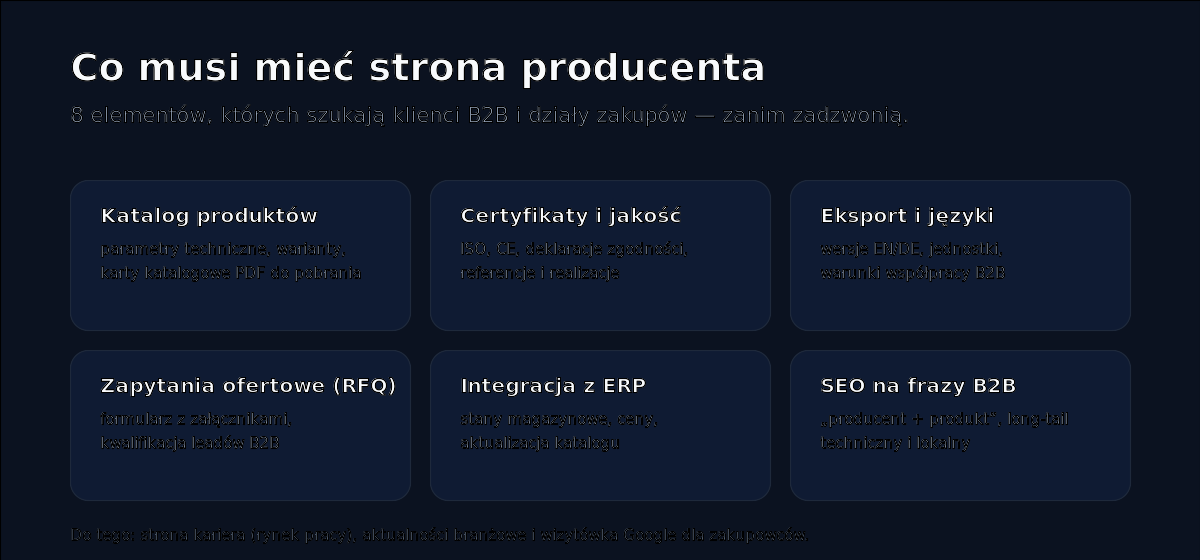
This article lists the 8 elements a manufacturer website needs to generate RFQs: from a product catalogue with parameters, through certifications and ERP integration, to SEO for technical queries. You will also find cost ranges and the typical mistakes I see in industrial projects.
What B2B buyers look for
Before you design the structure, understand the intent. A B2B buyer — a technologist, purchaser, designer — lands on your site with a specific need and little time. They look for three things: can you produce what I need (parameters, production range), can I trust you (certifications, references, company size) and how fast can I get a quote (RFQ form, contact to a salesperson).
A site that answers these three questions within the first 30 seconds collects enquiries. A site with “we are a market leader” and a stock photo of a hall collects nothing. In B2B, specifics win: numbers, tolerances, materials, capacity, lead times.
Product catalogue with technical parameters
The heart of a manufacturer site is the product catalogue. Not a photo gallery, but a database with real data: catalogue names and codes, parameters in tables, available variants and sizes, materials, tolerances, operating conditions. Every product should have its own URL (not live inside a PDF) — those URLs are what rank in Google for “manufacturer [product] [parameter]” queries.
Add downloadable PDF datasheets, technical drawings and high-quality product photos. A procurement department that cannot download a datasheet looks elsewhere. An “ask about this product” form on every product page halves the path to an enquiry.
Certifications, quality and references
Manufacturing is a purchase loaded with risk — certifications are the currency of trust. A manufacturer site must show: ISO and other system certificates, CE declarations of conformity, industry approvals, the machine park with specifics (type, year, capabilities), company size (years in business, headcount, capacity) and case studies with client names where contracts allow.
An “about us” section with numbers (“since 1998, 120 employees, 3 production lines, 2,500 tonnes per year”) works better than paragraphs about passion for manufacturing. Add industry references and — if you have them — Google reviews.
RFQ forms instead of a plain contact form
A “name, email, message” form is not enough for B2B. A manufacturer’s request for quotation includes: product or category, quantity or batch, required parameters, deadline, attachments (drawing, specification) and company details for quoting. A well-designed RFQ form qualifies leads — you know immediately whether it is a 50-piece enquiry or 50,000.
- The form should: send a confirmation to the client, deliver to CRM or the sales inbox, include anti-spam protection and attachment limits. For foreign clients — an English version with units of measure and Incoterms.
Export and language versions
If you export, a Polish-only site cuts half your market. An English version is the baseline (30–40% of the build cost), German for DACH markets, Czech and Slovak for the region. Each version needs not a translated menu but a full implementation: URL structure, hreflang, content with technical phrases in that language.
In foreign-language versions include the terms of cooperation: minimum order quantities, payment terms, Incoterms, lead times, logistics. A buyer from Germany who cannot see those terms writes to the competitor who shows them.
ERP and business system integration
A manufacturer with an ERP system holds a treasure — provided it connects to the website. Integration lets you publish stock levels, update B2B pricing, export the catalogue to files and take orders straight into the system. It saves dozens of hours per month of manual catalogue updates.
The scope depends on the system (Subiekt, Comarch ERP, SAP, WMS platforms) and usually requires a dedicated API module — a 3,000–15,000 PLN line in the quote that pays for itself with the first major catalogue update or sales-team time saving.
SEO for technical and local queries
B2B buyers search with long, specific phrases: “manufacturer of [product] in [material]”, “[product] custom CNC”, “sheet metal stamping [city]”, “[product] wholesale”. These phrases have lower volume but such high purchase intent that one Google enquiry can be worth a contract of thousands.
- Manufacturer SEO rests on: separate URLs for products and categories, descriptions with parameters (not slogans), structured data, expert content (technical guides) and a Google Business Profile for buyers searching locally. Add a news section and industry publications — a signal the company is alive.
Careers page — manufacturers compete for people
The manufacturing labour market is tough, and the careers page is your shop window for candidates. A section with company culture, benefits, development paths, a plant gallery and real employee stories lowers recruitment costs. Publish current openings with quick applications — candidates check the company website before the interview.
Cost of a manufacturing company website
| Scope | Net price | Timeline |
|---|---|---|
| Corporate site with a basic catalogue (no integration) | 5,000–12,000 PLN | 4–6 weeks |
| Product catalogue with parameters and PDFs (100–500 items) | 8,000–20,000 PLN | 6–10 weeks |
| English version (+ German) | +30–50% of base price | +2–4 weeks |
| ERP integration (stock, pricing) | 3,000–15,000 PLN | 2–6 weeks |
| RFQ form with lead qualification | 1,500–4,000 PLN | 1–2 weeks |
| Technical care after launch | from 300 PLN/month | ongoing |
The biggest line is usually the product catalogue — the work is mostly organising data that lives in spreadsheets and technologists’ heads. The good news: done once, it serves for years.
Typical manufacturer website mistakes
A catalogue in a PDF instead of on the site. PDFs do not rank, cannot be searched and do not lead to an RFQ.
No technical parameters. A product photo without data means zero information to a buyer. A table with tolerances and materials — that is content that sells.
Hidden contact details. A phone number buried in the footer, a form without an email address, no sales department. B2B buyers want to talk to a human — show contact on every page.
A site from 2015 with no updates. To a buyer it looks like a company that may not exist next year. Fresh content is a credibility signal — for Google too.
No foreign-language version while exporting. The most common mistake among manufacturers with export potential. An English version is not a cost, it is a sales channel.
Frequently asked questions
How much does a website for a manufacturing company cost?
A corporate site with a basic product catalogue costs 5,000–12,000 PLN net. An extended catalogue with specifications, PDF datasheets and filtering 8,000–20,000 PLN. Foreign-language versions add 30–50% of the base price, and ERP integration 3,000–15,000 PLN. Full ranges are broken down in the website cost article.
Does a manufacturer need an online store?
Not always. Many manufacturers sell through requests for quotation, not a cart — and for them an RFQ form beats a store. A store makes sense for standardised products with clear pricing (parts, materials, components). Some companies combine both: a catalogue with RFQ for project clients and a B2B store with price lists for regular buyers.
How do I present a catalogue of 500 products?
Best in a structure of categories and subcategories with separate URLs for each product, parameter filtering and PDF export. For large catalogues, integration with the system where the data already lives (ERP, PIM, spreadsheets) is key — entering 500 products by hand takes weeks and invites errors. Write unique descriptions: text copied from a component supplier’s catalogue does not rank.
Is an English version of a manufacturer website worth it?
If you export or plan to — yes, it is a priority. An English version opens the market to clients who do not speak Polish and signals international credibility to Google. The cost is 30–40% of the base build. Avoid half-measures: machine-translating the whole site without optimising technical phrases does more harm than good.
How do I win RFQs for a manufacturer website?
Three pillars. First: SEO for technical and long-tail phrases (“manufacturer of [product] [parameter]”) with high purchase intent. Second: an RFQ form with attachments and a fast sales response. Third: expert content (technical guides, case studies) that builds trust and attracts links. Add a Google Business Profile and industry directory listings.
Does a manufacturer need a company blog?
A manufacturer’s blog is not content for content’s sake — it is an SEO and sales tool. Technical guides (“how to choose [product] for [application]”), material analyses, case studies from client projects — these attract buyers during research and build expert positioning. Two articles a month is the pace that shows visible traffic and enquiries within a year.
📖 See also: How much does a website cost in 2026?, the 7-stage website development process and the business website development guide. See our website development service — product catalogue, RFQ and language versions in one build.